
AU Student Researcher Unlocks a Modern Medical Mystery
Almost six years after the pandemic began, the scientific community remains confounded by long COVID.
Since 2020, World Health Organization (WHO) data indicates that nearly 47 million people globally have developed the condition—roughly 6 percent out of the 779 million reported COVID-19 cases worldwide.
From chronic fatigue and “brain fog” to respiratory distress, patients have reported more than 200 symptoms that persist for at least three months after an initial infection. Despite the scale of the crisis, there are no therapeutic interventions for the chronic ailment, which is also referred to as post-COVID condition.
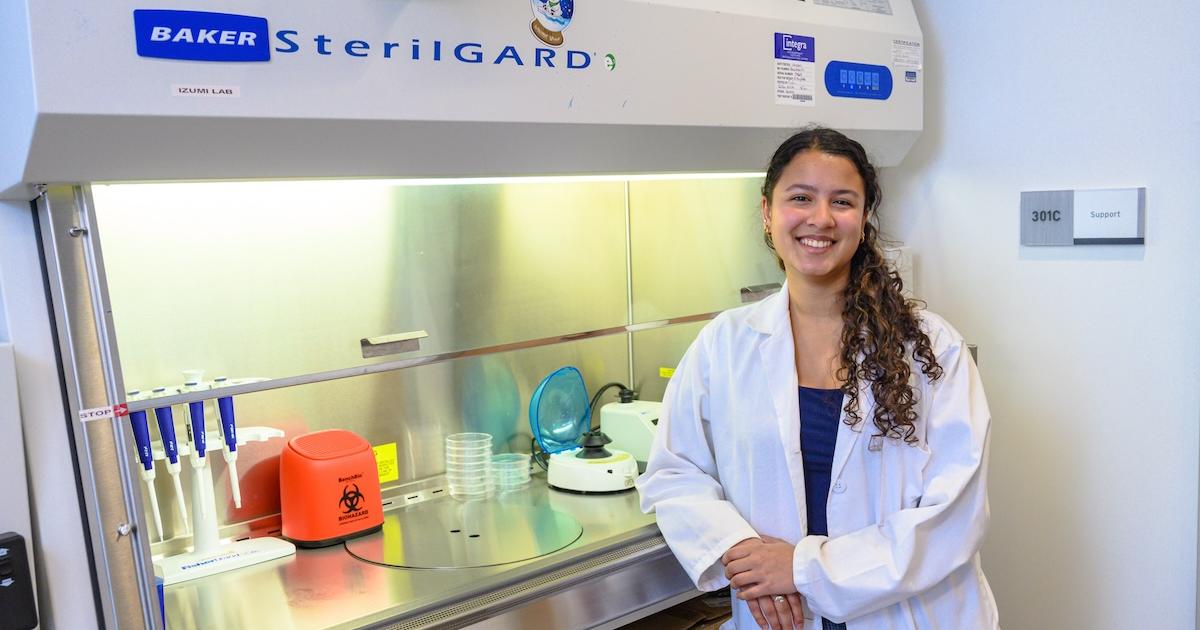
For the last 18 months, American University student researcher Sophia Gagliardi, CAS/BA ’26, MS ’27, has been working to shed light on this molecular mystery. Working under the guidance of biology professor and virologist Taisuke Izumi, Gagliardi is searching for the root cause that has eluded so many.
 “We know what long COVID is, [and] we know people are trying to treat it, but nobody’s been able to find out what’s causing it” or how that cause leads to such a wide range of symptoms, Gagliardi said. “The further we can get with this, the closer we can get to actively helping people.”
The project hit a turning point in March 2025. After nine months of trial and error, Gagliardi established a breakthrough method for a non-replicating, non-pathogenic, non-contagious virus in the lab using Virus-Like-Particle technology. This optimized assay enables safe infection experiments for undergraduate researchers at AU—and was the missing link the team needed.
“Before establishing this method, we were very much struggling,” Izumi said. “All our experiments failed, and we didn’t have any idea how to fix it.”
With a stable methodology in place, the team began studying the virological significance of angiotensin, a family of hormone-like peptides. Through rigorous experimentation, Gagliardi and her colleagues discovered that angiotensin IV—which plays a critical role in regulating blood pressure and fluid intake—increases the infectivity of the SARS-CoV-2 virus.
 This discovery implies a potential biological explanation for why long COVID manifests differently across the population. Because long COVID appears to be more prevalent in females, the AU researchers hypothesize that angiotensin IV concentrations in the female brain may be higher, and that this could be one reason why females are more susceptible to long COVID symptoms.
“Our observation is a breakthrough in the initial understanding of the molecular mechanisms underlying endocrinology of humans related to long COVID,” Izumi said.
Gagliardi’s commitment to her COVID project earned her the inaugural SARS-CoV-2 fellowship in virology, allowing her to transition to full-time research over the summer in the Izumi Lab. Now, she balances 15 hours of lab work per week in the Hall of Science with her academic load, supported by the Gloria Linkins Endowed Scholarship through the fall 2025 semester. To date, she has published five papers, serving as the lead author on two.
Notably, Gagliardi has ensured that all of her findings are published in open-access journals, making the data free and accessible to the scientific community. She said her hope “is that other people will see this research, start to test these peptides, and take it further.”
The Izumi Lab is now investigating the effect of angiotensin 1-7, another peptide within the Renin-Angiotensin System, on SARS-CoV-2 infection. In a separate study, Olive Lantz, CAS/BS ’25, MS ’26, has found that angiotensin 1-7 inhibits viral infection, the opposite effect Gagliardi uncovered with angiotensin IV.
Since angiotensin 1-7 levels in peripheral blood are higher in females than in males, this indicates that, while females are more susceptible to long COVID, they may also be more resistant to acute COVID infections than males.
 This also provides some clues about why females have been shown to have less severe acute COVID in the respiratory tract than males, in part due to higher circulating angiotensin 1-7 levels in peripheral blood. Both Lantz and Gagliardi will present their research at the Robyn Rafferty Mathias Student Research Conference on March 28 and at the American Society of Microbiology Conference in DC this summer.
As Gagliardi completes her combined bachelor’s and master’s program next year, she is already looking toward a future in research or medical school. For the New Jersey native—who chose AU for the rare opportunity to conduct high-level research as an undergraduate at an R1 institution—the work is as much about passion as it is prestige.
“This is the experience I wanted [at AU],” Gagliardi said. “I go in, do cool experiments, and come back and tell my friends, ‘I worked with viruses today.’ It’s very fulfilling for my inner child.”