Join the ARPC email list
Subscribe to the mailing list for updates from the Antiracist Research & Policy Center!

The Antiracist Research and Policy Center stands as an interdisciplinary hub for the study and practice of racial justice. We catalyze and conduct research that generates critical knowledge around race, power, and difference and informs the work of policymakers reckoning with race and imagining worlds beyond domination.
General Inquiries:
202-885-2892
[email protected]
Media Inquiries:
AU Communications
[email protected]
202-885-5950
We invite you to read our 2026 annual report, familiarize yourself with current commitments, support us through a donation, or make use of the open-access resources on this site.
On September 9 in the Battelle Atrium, the ARPC showcased its initiatives in our first Center colloquium: “Universal, Indivisible, Interdependent, and Interrelated”: Human Rights Work at the ARPC in the 25th Year of Durban.” We thank all of our presenters and attendees and look forward to continuing the work!
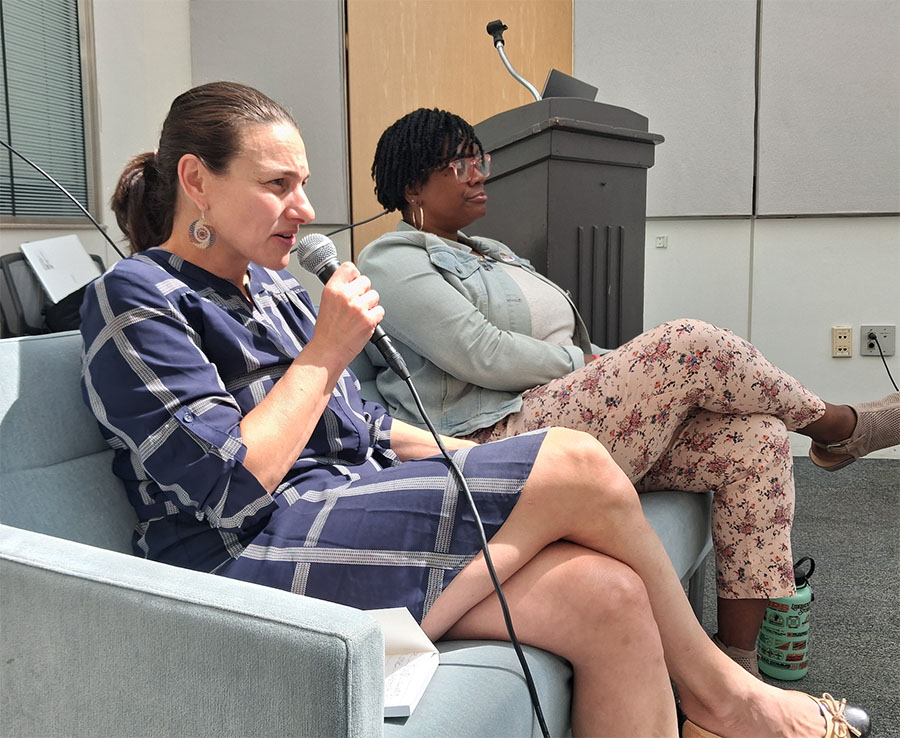
School of Ed. Professor Samantha Cohen and Teaching for Change community partner Nakeesha Ceran discuss antiracist program design and support of educators in the current sociopolitical climate.
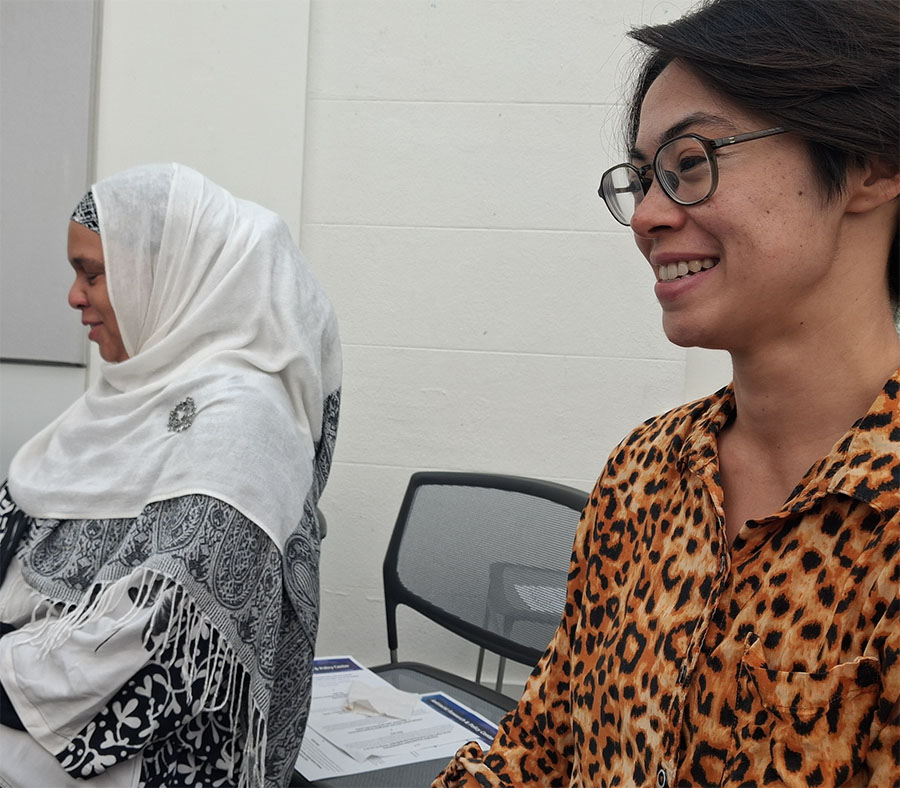
School of Ed. Professor Amaarah Decuir and Sociology Professor Sarah Iverson watch a short film by student J-Lin De Los Santos.
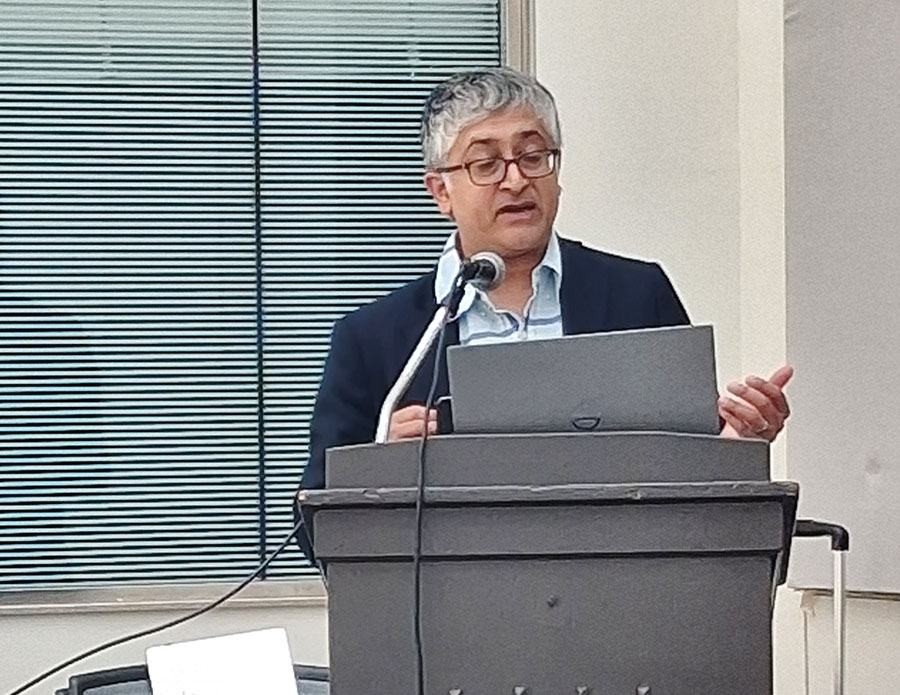
History Professor Gautham Rao discusses his book White Power: Policing American Slavery.
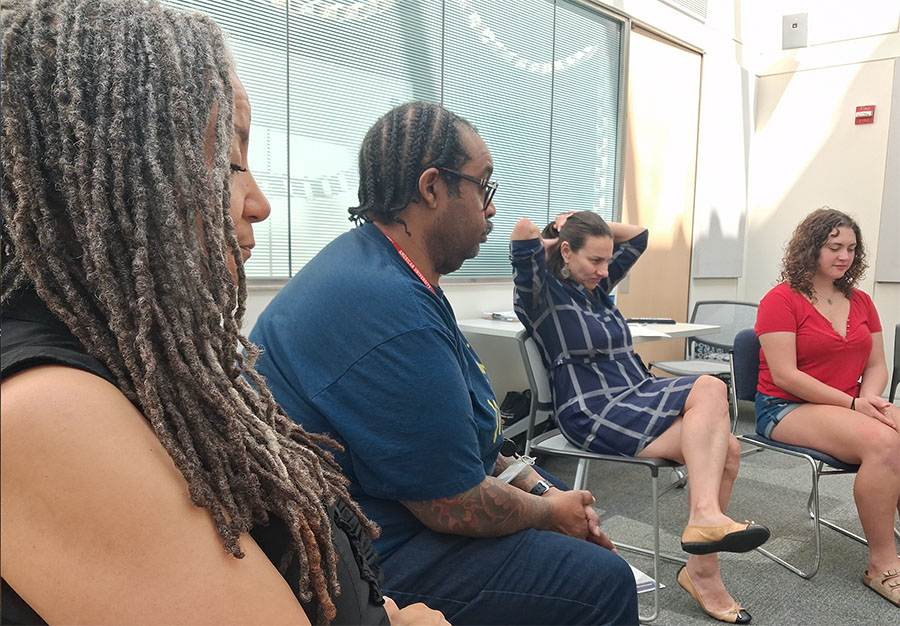
Faculty and students participate in ARPC Doctoral Fellow Dave Tranchtenberg's dialogue circles.
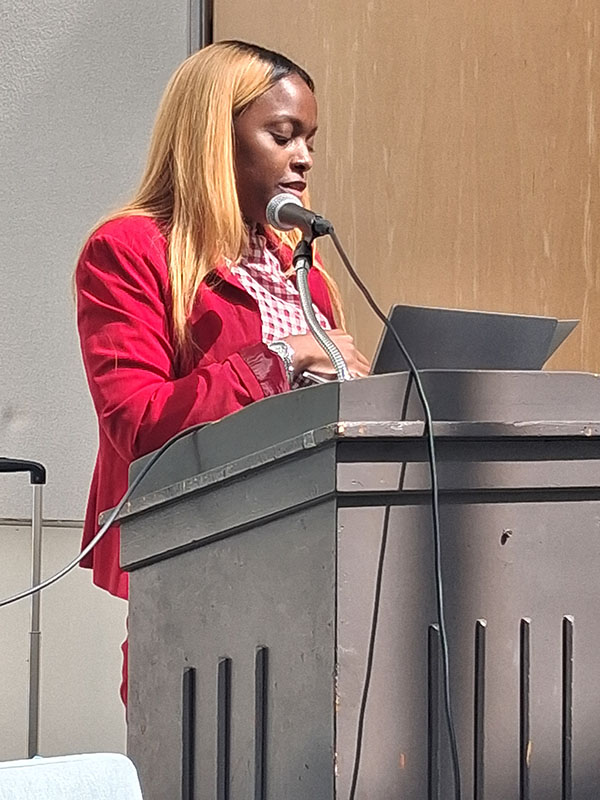
ARPC Post-Doctoral Fellow Shané Weaver speaks on Black beauty culture and public scholarship.
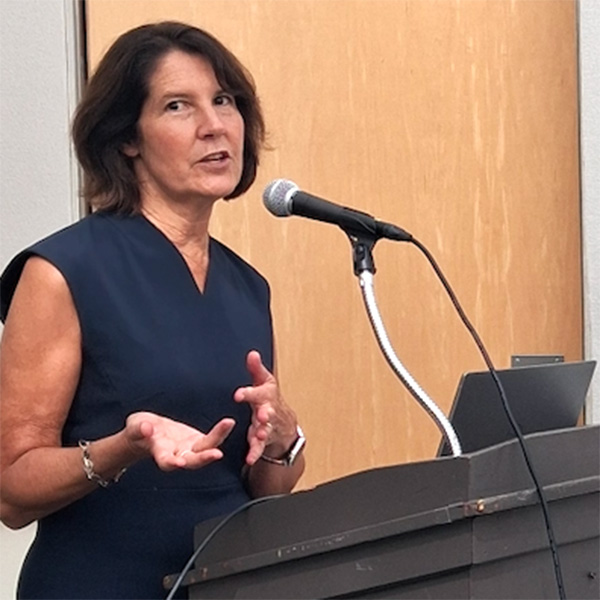
CAS Dean Aldoory kicks off the colloquium with the opening message.
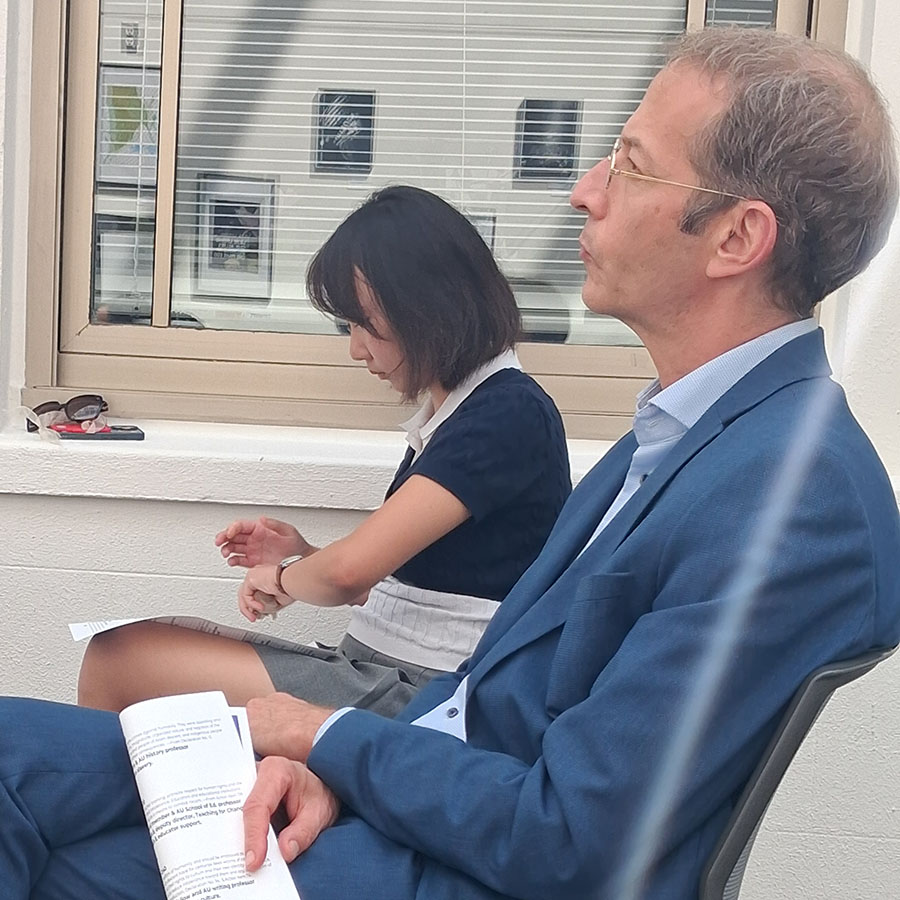
History Professor Max Friedman and a student listen to Dr. Rao discuss his book.
The ARPC is proud to announce its collaborative partnership with Teaching for Change (TFC): home of the Zinn Educational Project and national supporters of antiracist educators engaged in “questioning and re-thinking the world inside and outside their classrooms.” We will soon welcome AU alum, recipient of AU’s MLK Jr. Visionary Award, and TFC Deputy Director Nakeesha J. Ceran to the ARPC Advisory Board.

We are also proud to report on ARPC scholar Noah Green’s work with Congresswoman Rashida Tlaib. Throughout the summer, Noah served as Congresswoman Tlaib’s Communications and Press Intern. Among other things, Noah translated legislative and political communications into language, press materials, and resources that are accessible to residents of Michigan’s 12th District and the broader American public. Noah says that in this role he learned that “the work of political communications is the work of helping people recognize the forces shaping their lives, understand what is being done in their name, and access the resources available to them.” We congratulate him on an important job, well done.

This year, we join in celebrating the 25th anniversary of the United Nations High Commission for Human Rights’ Group of Independent Eminent Experts (GIEE) on the Durban Declaration and Programme of Action (DDPA): the international blueprint and roadmap to address “racism, racial discrimination, xenophobia and related intolerance.” We are thrilled to partner with the Group on a number of initiatives that move our mutual mission forward.
Dr. Sarah Trembath, Interim Director of the Antiracist Research and Policy Center (ARPC) at American University, has been recognized with AU’s Inclusive Excellence Award. This honor reflects her sustained commitment to advancing equity through teaching, research, and institutional leadership. She has also been appointed Director of ARPC for a three-year term, reflecting the university’s confidence in her leadership and vision.
Celebrating the work of ARPC affiliates associated with the Race, Climate, and Agrarian Justice Lab. Their April 27 convening continued the Lab’s vital work at the frontlines and intersections of agrarian politics, racial equity, and climate justice to collectively envision and strategize how we create agricultural policies and systems that truly nourish and sustain life. This event built on their 2023 Pointing the Farm Bill Toward Racial Justice Summit and subsequent 2024 Toolkit connecting advocates, farmers, and scholars to generate actionable analyses.
Announcing the Affiliate Research and Dialogue series. This summer we begin our ongoing spotlight interviews with ARPC affiliates. Check out our Affiliate Interviews page (coming soon) for the first three in our series: SIS’s Dr. Tazreena Sajjad, SIS’s Garrett Graddy-Lovelace, and Performing Arts’ Dr. Omi Davis-Smith.
Celebrating our scholars. Congratulations to Sonia Sanchez Social Justice Scholars J-Lin Dos Santos and Ngolga Omekongo for completing their projects! Please look for J-Lin’s short film on humanizing immigrants, Ngolela’s website in support of Congolese women, Noah’s critical consciousness raising public-education framework, and Eva’s website supporting pretrial adjudicated youth at the Scholars’ colloquium on September 9th, 2026 in Battelle atrium.
The ARPC is pleased to announce our collaborative connection to the United Nations’ High Commission on Human Rights. This past fall, the ARPC hosted the University of Pretoria’s Dr. Joel Modiri for a discussion of his scholarship and his antiracist work with the United Nations. At the University of Pretoria, Dr. Modiri is chair of the Department of Jurisprudence. At the UN, Dr. Modiri is a member of the 5-person Group of Independent Experts on the Implementation of the Durban Declaration and Programme of Action—the UN’s “blueprint to combat racism, racial discrimination, xenophobia and related intolerance globally.” He represents the entire region of Africa in that role.
For the foreseeable future, beginning this summer, ARPC researchers will collaborate with Dr. Modiri. We will work together on developing measures to assess UN member states’ adherence to the principles of the UN’s groundbreaking policy. We are all looking forward to this meeting of minds.
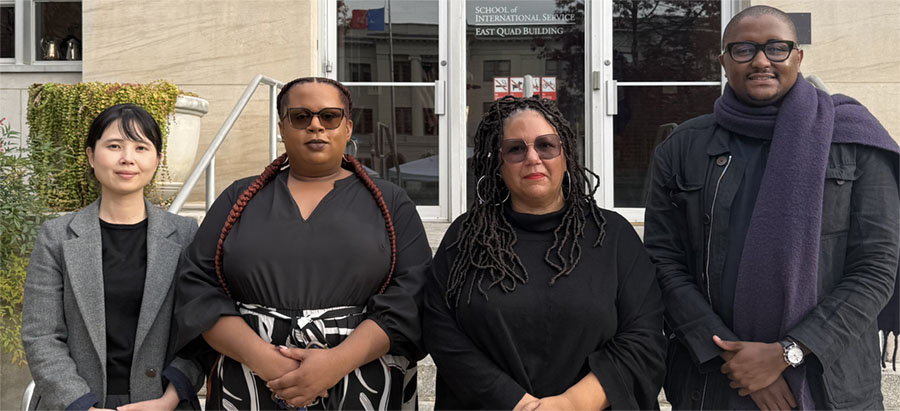
Dr. Joel Modiri visits the Antiracist Research & Policy Center. Photo courtesy of Qudsia Saeed.
We are also thrilled to announce the Spring 2026 Sonia Sanchez Social Justice Scholars. This pilot program is designed to honor the life and work of the great professor, poet, and social justice worker Sonia Sanchez. The ARPC wishes to uplift her in her lesser known role as one of the premier architects of the Black Studies Movement and to nurture undergraduate students who show promise of following in her pioneering path.
Awardees will undertake independent study with the ARPC interim director and design an initiative in their area of interest. They will also be given modest sum funding to undertake some aspect of it and then will write it up for publication on the ARPC website. Join us in congratulating this year’s scholars, each of whom was nominated by a professor and selected by ARPC leadership:Ngolela Omekongo, Noah Green, J-lin De Los Santos
This fall, the ARPC welcomed our fellows—Communications Lead, Esperonto Bean, MA; Postdoctoral Fellow in Research Translation and Writing, Shané Weaver, PhD; and Doctoral Research Fellow, Dave Trachtenberg, MS. Please see our Center Leadership page for more information about Mr. Bean. See our Fellows page for more information about Dr. Weaver and Mr. Trachtenberg.
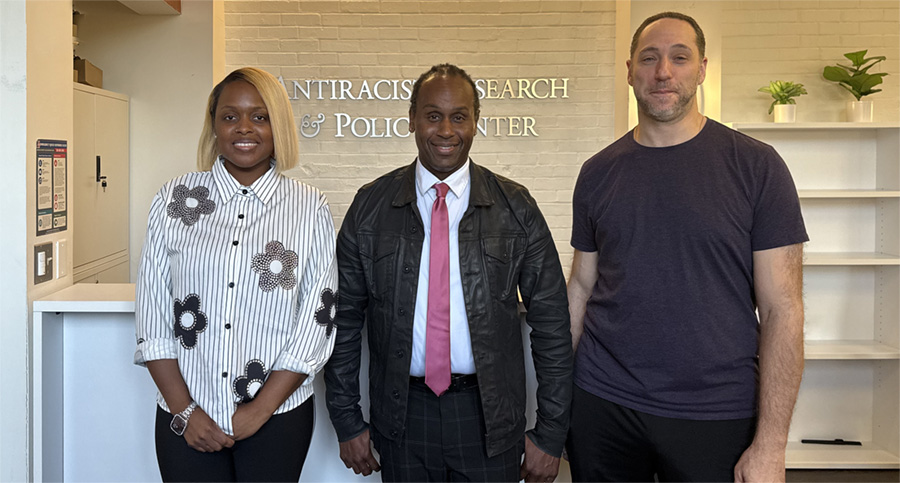
The ARPC would like to express our gratitude to the College of Arts and Sciences and an anonymous donor for awarding us funding for two summer fellowships. We will use the gift to support a doctoral fellow in our work with the UN’s Group of Independent Experts and another student fellow to begin policy analysis and advocacy work for the ARPC’s upcoming Truth in K–12 Education work. Interested AU graduate students should keep an eye out for a call for applications.
The Humanities Truck project entitled “Chocolate City Speaks: Hip Hop Emcees and Spoken Word Artists of 1990s DC” is looking for two students who will be in the DC area in June of 2026. Students will join Humanities Truck scholars and AU faculty in collecting and preserving oral narratives about pre-gentrification era hip hop artists from the DMV. Students with a vested interest in anthropology, sociology, history, archival research, and/or hip hop are encouraged to apply. Selected students will commit to one training session and four interview ridealongs and will receive a modest stipend.
The ARPC is excited to announce our partnership with the university’s Critical Information Literacy (CIL) Committee. As a field of study, CIL helps information-seekers evaluate and use credible sources and do so with the power dynamics of knowledge production in mind. The CILC—made up of university librarians and antiracist Writing Studies professors—encourages the AU community to think about knowledge in terms of who creates it, how it becomes valid as knowledge, who has access to it, and how aspects of identity, including race, class, gender, and sexuality, affect it all. This year, we will collaborate with the CILC in the creation and promotion of their Critical AI toolkit and the revision of their open-access Antiracist Praxis subject guide. For more on the committee and the field of CIL, please read the CILC Mission Statement.
Announcing the 2025–2026 fellows: The ARPC has awarded fellowships to three outstanding professionals whose antiracist work promises to make an impact on our campus community and in the fellows’ respective fields. We are thrilled to welcome Shané Weaver, PhD, as our postdoctoral Fellow in Research Translation and Writing; David Trachtenberg, MS, as our Doctoral Research Fellow; and Esperonto Bean, MA, as our Communications Lead. Please see our Fellows page for more information about them.
Announcing a special collaboration: This year, the ARPC is honored to have Mr. Matthew Hart on our team as an external social justice fundraising advisor to the ARPC’s Interim Year Advisory Board. Hart is currently Executive Director of the Global Philanthropy Project who spearheaded the extraordinary Fund Our Futures Campaign. He is also president of the Board of Directors of the Calamus Foundation and a board member of Funders for LGBTQ Issues. Formerly, he served as Senior Strategist for Europe for Funders Concerned about AIDS and National Director for Public Engagement at Solutions for Progress. Hart is a native of Philadelphia who currently resides in Paris, France. We welcome him with gratitude for his support of our vision!
Call for interns: The ARPC currently has two Spring-semester work–study positions open for undergraduate students interested in antiracist work. Our Communications Intern will work with the Interim Executive Director, Communications Lead, and Postdoctoral Fellow in Translated Research and Writing to create and adapt center messaging for student populations. They will also interview Antiracist Center affiliates and prospective affiliates for a number of purposes and assist in ongoing projects as needed. If this describes your interests, please navigate to AU Careers and look for FWS Communications Assistant (R3382). Our Research Intern will work with the Interim Executive Director and the Doctoral Research Fellow in a focus group project on somatic awareness in fruitful cross-cultural communications. If this describes your interests, please navigate to AU Careers and look for FWS Research Assistant (R3411).
Call for student volunteers: Are you interested in volunteering at the ARPC for college credit? Please email the center at [email protected]. Write “Attn: Nalani Love-Harris, for volunteer work” in the subject heading. Write one 3–5 sentence paragraph stating your major; your experience with antiracism as a field of study or an activist practice; and an idea of what skills you would be interested in sharing or cultivating in yourself.
Call for independent-study students: Do you have room in your Spring Schedule for a 1–3 credit course in which you are the sole student, who gets to design and implement an antiracist project? Are you interested in studying antiracist research with the Interim Director of the ARPC for college credit? If so, please email the center at [email protected]. Write “Attn: Dr. Trembath, for independent study” in the subject heading. Write one 3–5 sentence paragraph stating your major; your experience with antiracism as a field of study or an activist practice; and an idea of what you might like to study.
To the ARPC community, Hello!
I am delighted to reach out as this year’s interim executive director and welcome you to the 2025–2026 academic year.
I would also like to welcome you to the next stage in the life of the Center and invite you to be a part of this year of transition! There will be many opportunities for you to participate in what we feel are exciting and impactful initiatives.
As students, staff, faculty, administrators, and community partners dedicated to the study, analysis, and up-ending of racism and its intersectionally interrelated dynamics, you should know that I am with you on your concerns about the current sociopolitical moment. I am also energized by the possibilities in what the times require of us. I remind myself daily that the scholar-activists I’ve long admired all did their best work—in the community and through the academy—under serious societal pressures: Anzaldúa, Ngũgĩ, Lorde, DeLoria, Chomsky, Said, Emma Gee, Walter Rodney, Jack Forbes, and so many others moved the needle on social justice in tumultuous times. And so, as I settle into my work space at the ARPC, I am placing framed images of such people on my shelves. This act serves as a reminder of what is possible with solidarity, communication, criticality, and unwavering focus.
Any acknowledgment of important scholar-activists should also include my three predecessors here at the Center. It’s an honor to inhabit a space previously held by such brilliant academics and dedicated social justice workers. What I have of their initiatives will be preserved here and will remain for the foreseeable future.
The ARPC’s 2025–2026 program will fully roll out by the beginning of October. As the site evolves over the next month, it will likely be a bit of a melange of the incoming and outgoing teams. Please hang in there and check back! There will soon be an updated and future-focused site to explore. Among other research and policy-based initiatives, student participation and engagement will be a focus throughout the year.
In peace,
Sarah Trembath, EdD
2025-2026 Interim Director
Senior Professorial Lecturer, Department of Literature, Writing Studies Program
The ARPC convenes antiracist scholars from decolonial, pluriversal, and other intersectionally liberatory traditions. Together, we undertake research agendas, shape community partnerships, advocate for truth, and inform policy initiatives that expand true democracy and advance justice in all its dimensions.
Our work for the foreseeable future will be organized along these themes:
The research and policy work described on this site is built on our commitment to antiracist work in this moment...those praxes and priorities most relevant in these tense but hope-filled times. The Commitments, below, shape the Executive Director’s three-year plan and will guide the Center’s work during her term.
Research: In this posttruth anti-antiracist era, conjecture is often stated as fact. Mis- and disinformation abound. To the harm of marginalized people, pseudoscience has returned. Our work makes clear our commitment to scientific, methodical, controlled, peer-reviewed, and replicable research and our respect for non-Western empirical ways of knowing.

Theory: In the academic tradition, theory offers lenses and vocabularies through which to view and discuss our concerns. On our website and in our publications, we embrace theory. We also name our theoretical orientations, whether that intellectual work informs scientific study or scholarly discourse alone.

Perspective: Everything that is expressible comes from a thinker’s perspective, even those things that seem “neutral,” "objective," or “unbiased.” The ARPC warns that unexamined bias and false neutrality feed prejudice and can cause harm. Instead, we practice viewpoint transparency and openly reveal our sources.

Criticality: As members of a university campus, we value the analytical processes of critical thinking. As antiracists, we extend criticality toward examining systems of power and revealing ideologies that drive real-world injustice. Much of the open-access work on our Media and Communications page and our Critical Information Literacy page, for example, is grounded in this most important habit of mind.

Community: As a hub with many spokes, the ARPC relishes in its ability to connect people across committees, disciplines, departments, communities, and nations. We are growing our affiliate base, expanding it to nonfaculty staff and to antiracist faculty across a wide array of disciplines. We are also building partnerships with local, national, and international partners featured throughout this site.

Expertise: ARPC affiliates conduct high-impact research; generate novel theory; own their antiracist perspectives; practice criticality; and work hard for the policies and laws that will transform society toward its higher, more equitable potential. That work qualifies them as experts in their fields. They are scholars who dive deep, study closely, and bring bona fide knowledge to public policy, public discourse, and the academic tables at which they sit.
Policy: Just or unjust, laws and policies structure society and its institutions. When driven by political affiliation, emotion, or desire for personal gain, policy-making at all levels leans away from social justice and democracy. ARPC legislative analysis and policy work, however, is analytical, academically grounded, and empirically sound. (See our input to the UN High Commission for Human Rights’ Education and Racism Report; ask about the policy wing of our educational megastudy; and note the work of all of our politically engaged affiliates.)
Programming: Throughout its history, the academy has been a site of coloniality and oppression and a space of liberatory thought and action. In the current era, challenges to academic freedom curtail the latter and threaten to erase perspectives of minoritized people. Through our programming–especially our Dialogue Circles study–the ARPC steps out on the belief that even unpopular ideas, expressed in settings in which people practice civil discourse and radical listening, are crucial to the functioning of democracies and their systems.

Prosperity: Even in this time of major shifts in federal research funding priorities, the ARPC stands firm in its responsibility to draw in resources that enable our work to continue, grow, and spread. We live daily in our commitment to ethics-aligned fundraising, accountability, transparency, strategic spending, and thrift.
Subscribe to the mailing list for updates from the Antiracist Research & Policy Center!
Thank you for supporting the work of the Antiracist Research & Policy Center! Your donation will support our mission to seek the enactment of antiracist policies at the local, state, and national levels.