
Who Makes the Cut? Allan Lichtman Names 12 Presidents Who Transformed America
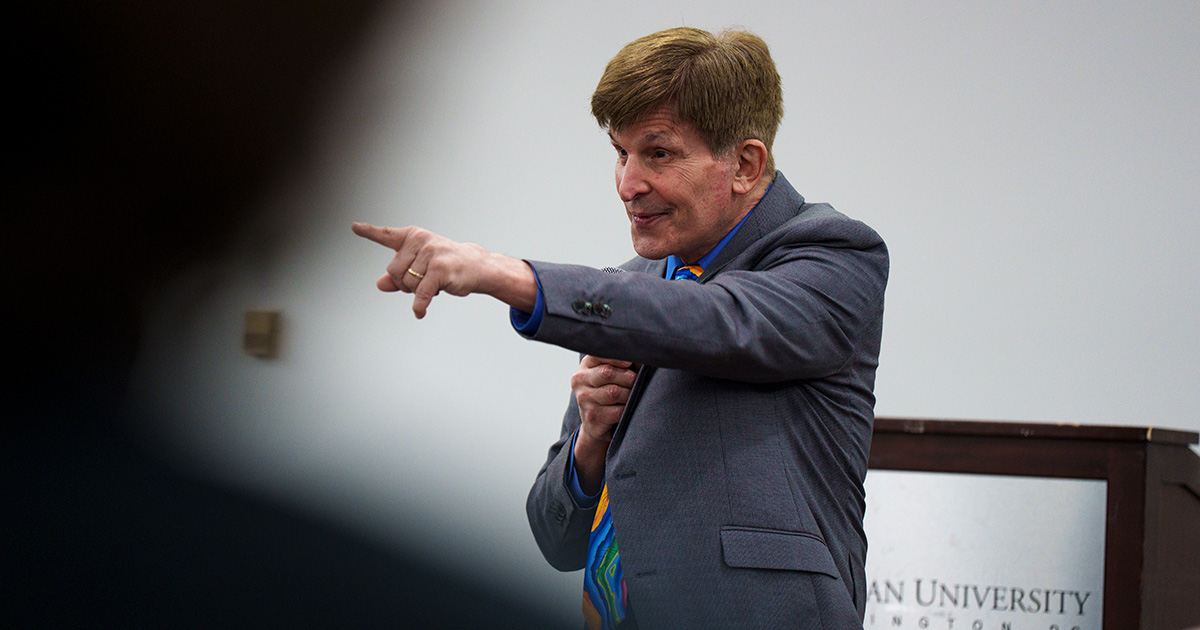 Professor Lichtman speaks at AU book signing event.
Eisenhower is out. Polk is in. And no president since Ronald Reagan made the cut.
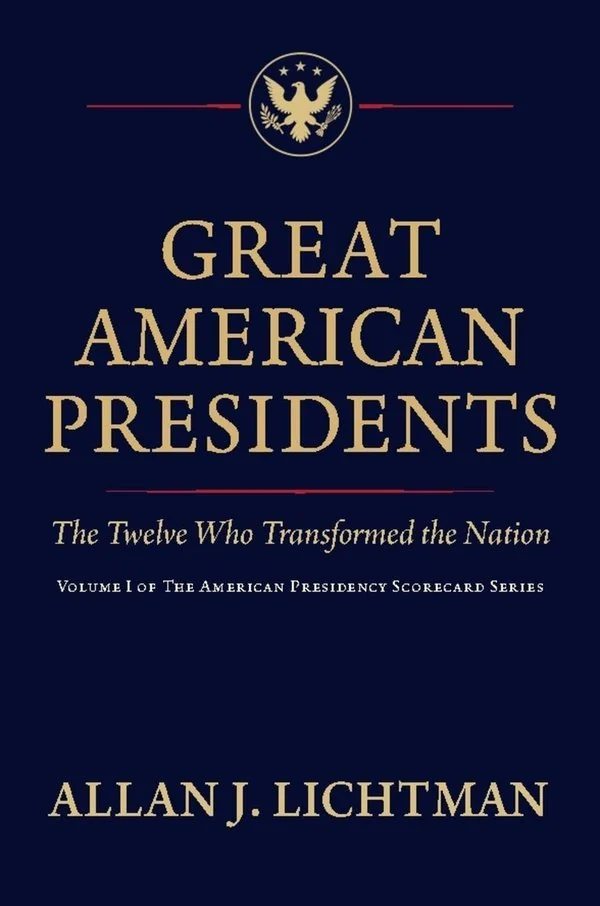
In his latest book, Great American Presidents: The Twelve Who Transformed the Nation (Bancroft Press), Distinguished Professor of History Allan Lichtman profiles 12 presidents who changed the course of American history and then assesses each one using his new “Ten Keys to Presidential Greatness.” Rather than emphasizing character, popularity, or political ideology, Lichtman's approach focuses on how profoundly a president changed the nation—for better or worse.
Here Lichtman discusses his unconventional rankings and offers his take on the 2026 midterms.
PH: In Great American Presidents, you introduce 10 keys to presidential greatness. How does your approach differ from past ranking systems?
AL: In Great American Presidents, my approach to presidential greatness differs fundamentally from the way historians and political scientists have traditionally ranked presidents. Those rankings typically focus on inputs: the qualities presidents bring to office, such as leadership, vision, character, and communication. My Ten Keys to Presidential Greatness focus instead on outputs: how a president actually transformed the nation. The Keys also let readers make their own judgments rather than simply accept mine. They also serve as a teaching tool, because applying them requires revisiting and assessing pivotal episodes in American history.
PH: You left Eisenhower off your list, even though he ranks highly with many historians. Why did James K. Polk make the cut instead?
AL: The omission of Eisenhower in Great American Presidents was the most difficult decision I made in ranking the presidents. I could not include every president I admired. My final choice came down to Eisenhower versus James K. Polk. I included Polk because he had a greater impact on the nation than Eisenhower.
The choice of Polk has sparked the most discussion. He was a one-term president and a racist and imperialist. However, he had a profound impact on the nation. He settled the Northwest territorial dispute with Britain, giving the nation Oregon, Washington, and Idaho. He fought a racist, pretextual war against Mexico, but the outcome gave the US California and much of the Southwest. During his brief tenure as president, the nation expanded by roughly two-thirds.
The keys do not depend on my political views, on a president's popularity, or on other scholars' rankings. They depend only on what each president accomplished.
PH: Which other president on your list do you think is particularly misunderstood?
AL: Along with Polk, Lyndon Johnson. He is primarily remembered for the disastrous war in Vietnam. But that blunder must be balanced against his extraordinary legislative accomplishments across nearly every area of American life: civil and voting rights, medical care, poverty, education, the arts and sciences, consumer protection, immigration, and the environment. He largely completed the unfinished liberal agenda of Woodrow Wilson and Franklin Roosevelt.
PH: Why is Ronald Reagan the most recent president to make your list?
AL: Ronald Reagan is the last president included in Great American Presidents for several reasons. The extreme polarization of recent decades makes it difficult for a president to implement a legislative agenda and unite control. The vastly increased size and scope of the federal government makes presidents' tasks more difficult and complex. Since the end of the Cold War, the international environment has become more challenging, with multipolar threats from terrorist groups and adversaries such as Russia, China, North Korea, and Iran.
PH: We can't resist asking you about the 2026 midterms. What do the results tell us about the political mood of the country?
AL: The main message of the 2026 elections was that Trump pursued his own self-serving agenda and disregarded the needs of the American people. Four strikes stood against Trump and his party this year, an unprecedented combination in modern midterm history.
The first was the war with Iran. The second was the economy, above all the cost of everyday life. The third was corruption, grift, and an authoritarian challenge to American democracy. The fourth strike, the president's deep unpopularity, was simply the sum of the other three.
Republican candidates learned the truth of one of Lichtman’s laws of American politics: You cannot run away from your own party's president.
PH: Looking ahead to 2028, are there any early signs that could prove significant in the next presidential election, or is it too soon to tell?
AL: This election also has important implications for 2028. Midterm results are one of my 13 Keys to the White House. The Republicans' losses do not decide the next election on their own, but they count as a strike against the party in power. The results also tarnish the two frontrunners for the Republican nomination, Vice President JD Vance and Secretary of State Marco Rubio, who are closely tied to Trump's record.
At the same time, the election elevated my favorite dark horse for the Democratic nomination, Georgia Senator Jon Ossoff. He won reelection by nearly 18 percentage points in a swing state that Trump carried in 2024.
Learn More
Great American Presidents: The Twelve Who Transformed the Nation (Bancroft Press, 2026) is available through Bookshop.org. For more information about Professor Lichtman, visit his American University profile or his Lichtman LIVE podcast.