
How Interdisciplinary Collaboration Makes for Better Science
 Five American University STEM students got a rare glimpse at the multibillion-dollar biotechnology industry through a summer internship at United Therapeutics (UT) in Silver Spring, Maryland.
Jose Calvo, CAS/BS ’24, MS ’26; Olive Lantz, CAS/BS ’25, MS ’26; Sadie Levering, CAS/MS ’26; Gouri Ninave, CAS/BS, Kogod/BSBA ’26; and Hasset Tibebe, CAS/BS ’25 spent twelve weeks, from May to July, at the public benefit corporation, which develops novel pharmaceutical therapies used to treat rare diseases and manufactures human organs for transplants.
“I haven’t been exposed to a lot of the business complexities that make a biotech firm and science in general, a reality,” Calvo said. “We saw all these things that you generally only read about in class.”
Through UT’s Student Led Exploration and Development program, members of the top two groups reported directly to Shola Oyewole, CAS/MS ’89, UT’s vice president of digital innovation, whose job it is to turn innovative ideas into marketable products.
Rather than embed students in one department, Oyewole sent Eagles across the company to visit labs and learn from different departments, from marketing to medical affairs. He even dispatched them to satellite locations in Blacksburg, Virginia, and North Carolina’s Research Triangle Park.
“AU students are fantastic,” Oyewole said. “They’re very knowledgeable and hardworking, and they’re willing to explore things outside of their comfort zone, which is what is necessary if you want to be innovative.”
The valuable experiential learning opportunity came out of a spring 2025 biotechnology course (BIO-489/689) taught by biology professor Taisuke Izumi.
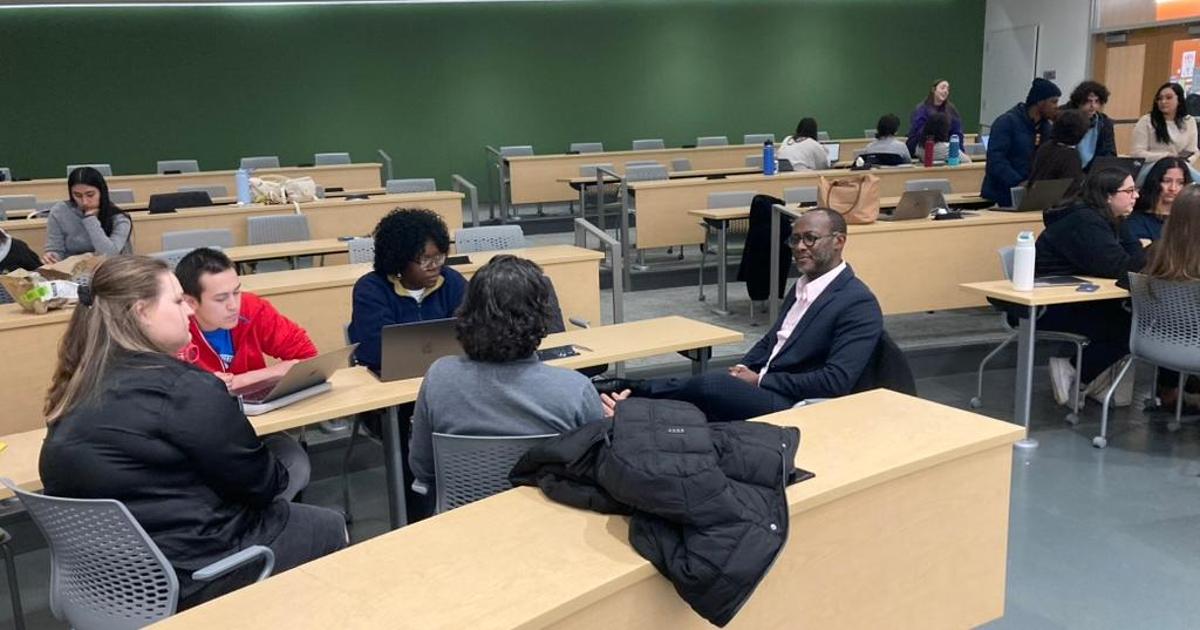
The class—sponsored by UT for the last two years—explores how entrepreneurship can maximize the impact of scientific innovation by challenging student groups to develop a noninvasive diagnostic tool for pulmonary hypertension.
“The class was a good opportunity to not only think about how to solve a really big problem, but also to take that problem and make it more consumable so that people can understand [it],” Levering said.
To simulate that process, groups had to draft a provisional patent application to protect their business idea. They also worked with AU’s Veloric Center for Entrepreneurship to develop their ideas and used a 3D printer in the Design and Build Lab to create a model human heart to aid in their understanding of human anatomy.
While working on the main assignment, a slate of 13 guest lecturers from academia, industry, law, government, and business—including Gisele Stolz, I-CORPS program manager at George Mason University; Melissa McGruder, senior director of regional nurse specialist programs at UT; and Stephanie Buchholz, a regulatory scientist at the European Medicines Agency—helped inform students’ approach to turning an idea into a start-up.
At the end of the semester, students presented their ideas during a business pitch competition judged by a panel of Kogod faculty members, biology professors, the National Science Foundation (NSF) I-CORP program director, and industry experts. Members of the top two groups, recognized for their outstanding contributions, were invited to intern at UT.
Izumi said the strength of the course is helping students learn to collaborate and leverage various fields to make science happen.
“One of the strongest aspects of AU is that it’s a multidisciplinary university,” he said. “When biology is more connected with business, law, public affairs, politics, and international societies, that gives us a bigger picture of career development for students.”
AU will continue to prepare students for impactful careers in the sciences with the new STEM Entrepreneurship in Biotechnology undergraduate certificate, a collaboration between Kogod and the biology department.
“Just getting a [science] degree isn’t enough anymore,” said Tommy White, Kogod/MBA ’95, director of the Veloric Center. “Folks are looking for business capabilities, skills, innovation, and an entrepreneurial mindset. The entrepreneurship certificate came out of [the need] to be more responsive to what employers are asking for.”