
Powering the Capital: American University Outpaces National and DC Peers in Federal Placement
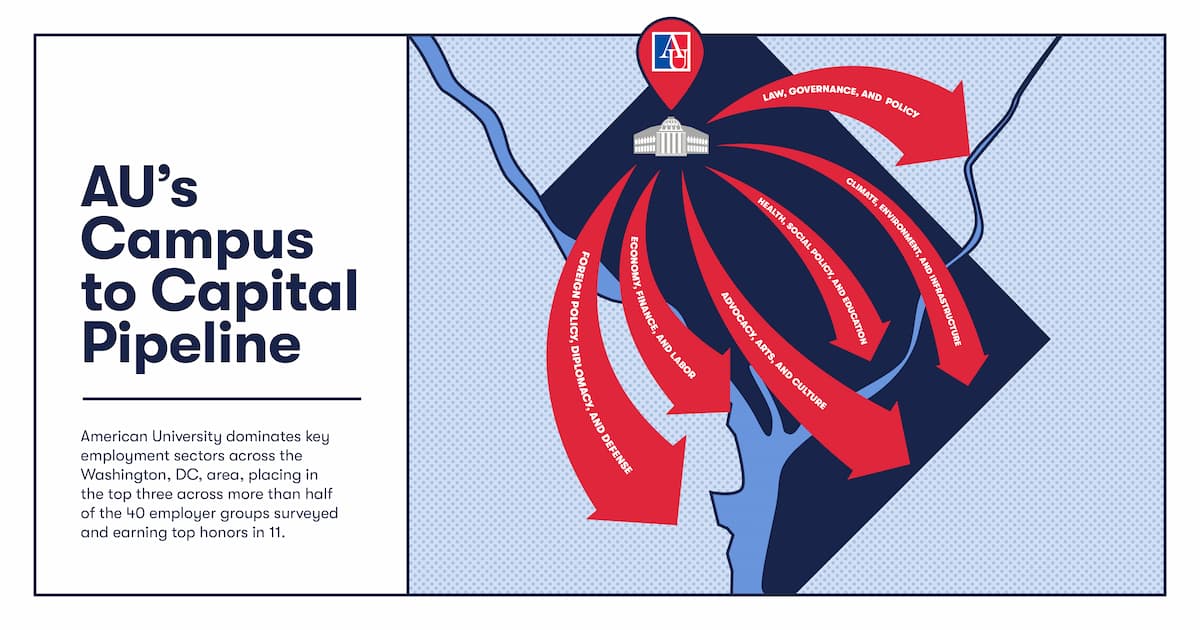
 American University sends a higher concentration of its graduates into the core corridors of the federal government and the Washington policy apparatus than any of its elite national and regional peers, according to an extensive dataset compiled by AU’s Office of Institutional Research and Assessment.
Measured against a national benchmark of 40 leading institutions—including Harvard, Columbia, Stanford, Johns Hopkins, and neighboring rivals Georgetown and George Washington University—AU captured the No. 1 ranking or tied for first in 11 of 40 surveyed employer groups.
The university also placed in the top three across more than half of the categories, underscoring AU’s role as an outsized talent pipeline into the executive and legislative branches.
AU swept outright first-place honors across five cornerstone institutions of national governance: the US Congress and the Departments of State, Homeland Security, Justice, and Commerce.
On Capitol Hill alone, more than 300 Eagles work as legislative staffers and lawmakers. Shannon “Shan” McDermott, SPA/BA ’18, director of operations and scheduling for Rep. Lizzie Fletcher (D-TX), credited AU’s focus on experiential learning with launching her career in the legislative branch.
“My senior-year internship is what got me my first job out of college—and that first job is what got me my current job,” McDermott said at the inaugural AU on the Hill Day, May 20, at the Rayburn House Office Building. “DC—and AU—is a place full of passionate people that all care about something. I bring that passion and care for serving constituents every day.”
That dedication to public service is woven into the university’s institutional fabric, said Alison Jacknowitz, dean of the School of Public Affairs.
“Preparing students to serve the public good was a founding principle of American University,” she said. “That was clear more than 90 years ago, when SPA was founded to help train federal employees to implement President Roosevelt’s New Deal. Ever since, we have prepared students to step directly from campus to the agencies and organizations that craft, implement, and evaluate policy that shapes the nation.”
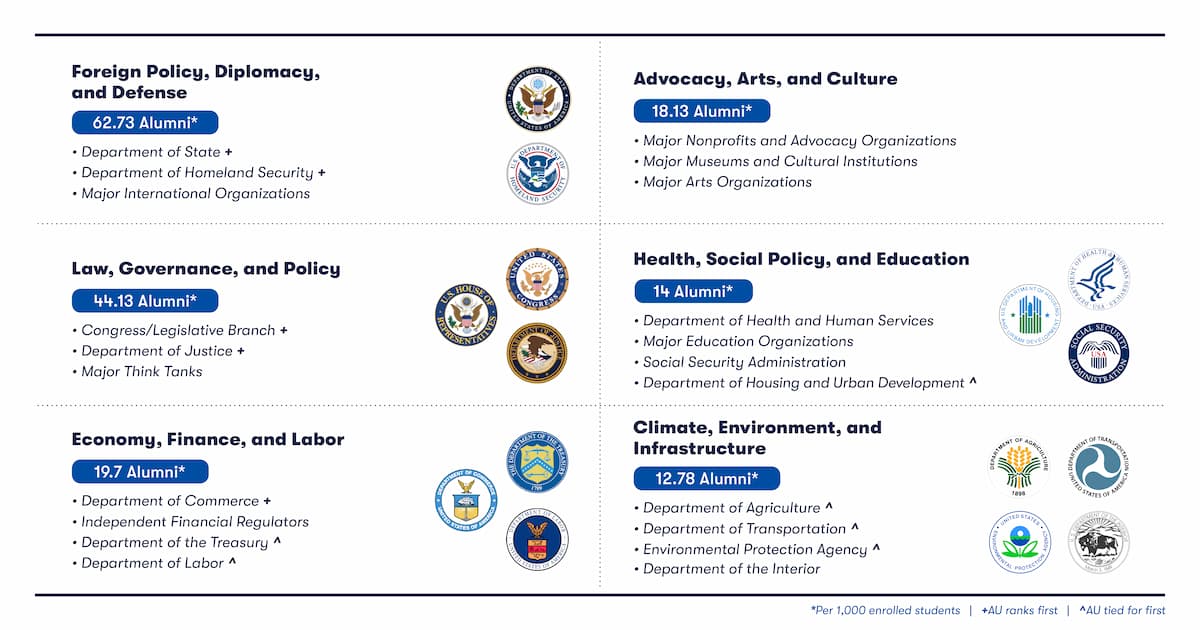
AU’s impact and influence extend across the federal regulatory, infrastructure, and environmental landscape. AU tied for first at the Environmental Protection Agency and the Departments of Agriculture, Transportation, Labor, Housing and Urban Development, and Treasury.
The findings—gathered from professional networking data between February and June 2026—hark back to AU’s founding identity.
Chartered through an act of Congress in 1893, the university was founded to train civil servants. When AU opened its doors in 1914 as a graduate school exclusively for federal workers, its first three alumni—the Class of 1916—hailed from the Department of Agriculture.
Beyond government administration, the analysis demonstrates that AU’s footprint spans the broader Washington policy and cultural ecosystem.
In policy and advocacy, AU placed No. 2 nationally at major think tanks—finishing ahead of Harvard and Princeton—and No. 2 at major nonprofit and advocacy groups. AU also captured the No. 3 spot at multilateral institutions such as the World Bank and the United Nations, outpacing both George Washington and MIT.
Across cultural and educational fields, the university secured the No. 2 ranking at major education organizations and major museums and cultural institutions, while placing third at major arts organizations.