
Art and Culture: Beizar Aradini

Beizar Aradini is a fiber and textile artist whose work threads personal history with collective memory. A graduate student at the School of the Art Institute of Chicago, Aradini examines Kurdish migration and the immigrant experience, particularly within the cultural landscape of the American South. Born in Mardin, Kurdistan, and subsequently raised in Nashville, Tennessee, following her family's immigration in 1992, she uses fiber as a medium for storytelling. In her creations, she frames stories that reflect themes of belonging and displacement.
Aradini's practice bridges generations and geographies. Through embroidery, digital weaving, and textile installation, she reimagines her family's migration story and reclaims overlooked Kurdish histories, especially those of women. Her art has been featured in exhibitions across the U.S. and abroad, including Bê Welat: The Unexpected Storytellers at nGbk Gallery in Berlin and We Count: First-Time Voters at the Frist Art Museum. This exhibition earned an Award of Excellence from the Tennessee Association of Museums. Her work has also been profiled in Nashville Scene and Native Magazine, recognized for its evocative blend of cultural reflection and craft.
In this interview, Aradini reflects on her artistic path, which has transitioned from painting to fiber arts, shaped by her artistic heritage and her mother's craft traditions. She recounts her experience within the diasporic archive, where memories often fill the gaps left by absent records. In her view, imagination serves as an essential instrument for preservation. Aradini aims to protect Kurdish heritage and promote women's voices through her art, inspiring new generations of artists.
- Can you begin by telling me about yourself?
- My name is Beizar Aradini and I am a fiber textile artist. I mostly work with family archives that show the transition of Kurdish migration from being refugees into immigrants, specifically in the South and the United States. I am currently a graduate student at the School of the Art Institute in Chicago, pursuing my master’s in Fibers and Material Studies. I’m going into my second year, and it's been a wonderful journey for my art career.
- How did you get started in art in general, and how did you find your interest in fibers and textiles?
- I've always dabbled in art, even as a kid, I remember being part of an art club. A lot of my family members were creative, though not professionally. It was just something we always engaged with. My mom, for example, would always make things with her hands, and I think I absorbed a lot of that early on. Later in life, I went to school for Fine Arts and got a BFA in painting, but I quickly realized I couldn’t connect with that medium. I’m a very tactile artist, I love working with my hands, so painting slowly transitioned into fiber work. It just made more sense; it felt very intuitive. I basically translated everything I learned from painting into fiber.
- How has your work with fiber evolved over the years, especially now that you’re pursuing your master's degree?
- I started with “painting with thread,” through embroidery and free-motion embroidery. That shift actually came from a conversation I had with my mom; she told me that women in the refugee camps used rice sacks as grids to cross-stitch onto pillowcases and blankets. At the time, I was struggling in my studio, and that story just lit something up in me. It felt like embodied knowledge, something deeply intuitive. So I picked up thread, and it all felt very natural.
- Now, I also do weaving, digital weaving on a TC2 loom, where I work with family and community archives, focusing on collective memory and how archives exist in diaspora. It’s about storytelling through fiber work.
- Could you elaborate more on the family archive that you’re working with?
- Working with photographs became really important because when my family fled from the Anfal genocide, they didn’t bring heirlooms. We barely had any photos of family members. The photos I’ve been able to archive really mark a specific time and space of Kurdish experience, especially the shift from refugee to immigrant.
- It’s also about understanding our culture and ourselves while being so far removed from our home country. For me, it’s been a form of learning about my own history, but also about truth-telling: resisting the erasure that happens so often. Turning archives into art is about sharing our stories and preserving our voices.
-
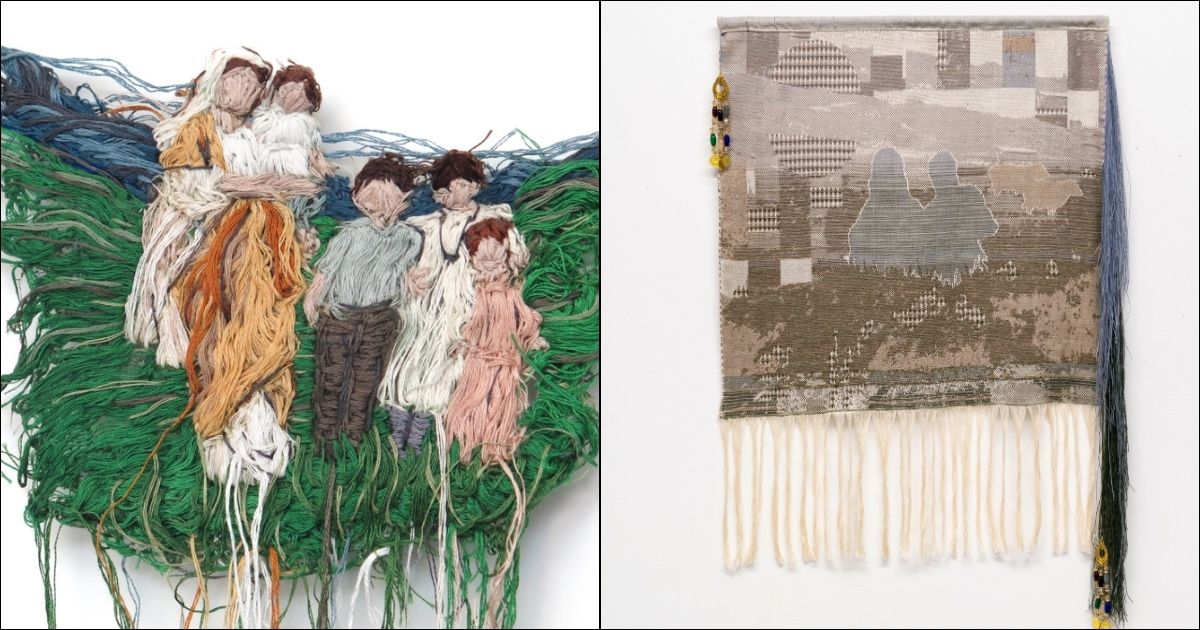
Left: Family Ties. Right: a place for us where the borders could not follow.
- How did it feel to explore your own personal history while also navigating collective memory? How do you balance those sources?
- It was very eye-opening. I grew up in a large Kurdish diaspora community where we were really able to hold on to and practice our culture. There’s a lot of shared history, but also each story is so different. My story is not the same as any other Kurdish person’s story, and I think that’s beautiful. There are overlaps, but we’re not a monolith.
- You’ve spoken a lot about your mother and the inspiration she provided. Can you talk more about her impact and other sources of inspiration?
- For a long time, I really focused on the women’s stories in my family. In most patriarchal societies, whether here in the U.S. or in parts of our own culture, women's stories are often the last to be told. But when it comes to surviving war and maintaining stability, so much of that falls on the women.
- So I’ve tried to center that in my art, to highlight Kurdish women. My mom is one of those women. Even though she never went to school, as she was constantly displaced and lost so many opportunities, she always made things with her hands. She would tell stories through drawing, often nature scenes or birds. Even my earliest ideas of imagination and creativity came from her storytelling. Her resilience and creativity were deeply inspiring for how I think and work.
- Have there been any unexpected discoveries or revelations for you in working with fibers and archives?
- I’m self-taught in fibers, so for a while I felt like I had to perfect everything. But once you let that go, you’re always surprised by what you can do.
- When embroidery came into my life through my mom’s story, it felt like everything just clicked, like all my worlds came together. I hated oil painting, and suddenly this thing appeared that made so much sense. It made my voice and my work stronger. That was such a beautiful, unexpected moment for me.
- With the importance of storytelling in your work, how do you navigate the gaps in the archives; times when there is little or no context?
- Archives from displaced communities often contain a lot of absence and loss. If you look at my work, you’ll notice that I often leave vast emptiness around the figures or manipulate the photographs by taking parts out or displacing people into new scenes. That’s reflective of what real archives are like for the displaced.
- To fill those gaps, I rely a lot on oral history and interviews, especially with my mom. I’ve asked her about her friends' lives, how they met, what their experiences were. A lot of my focus has been on life in the States, because that’s what I’ve experienced. But it’s also about imagining new images where the figures are real, but the spaces aren’t, kind of how collective memory works. It shifts, just like our identities shift in displacement.
-
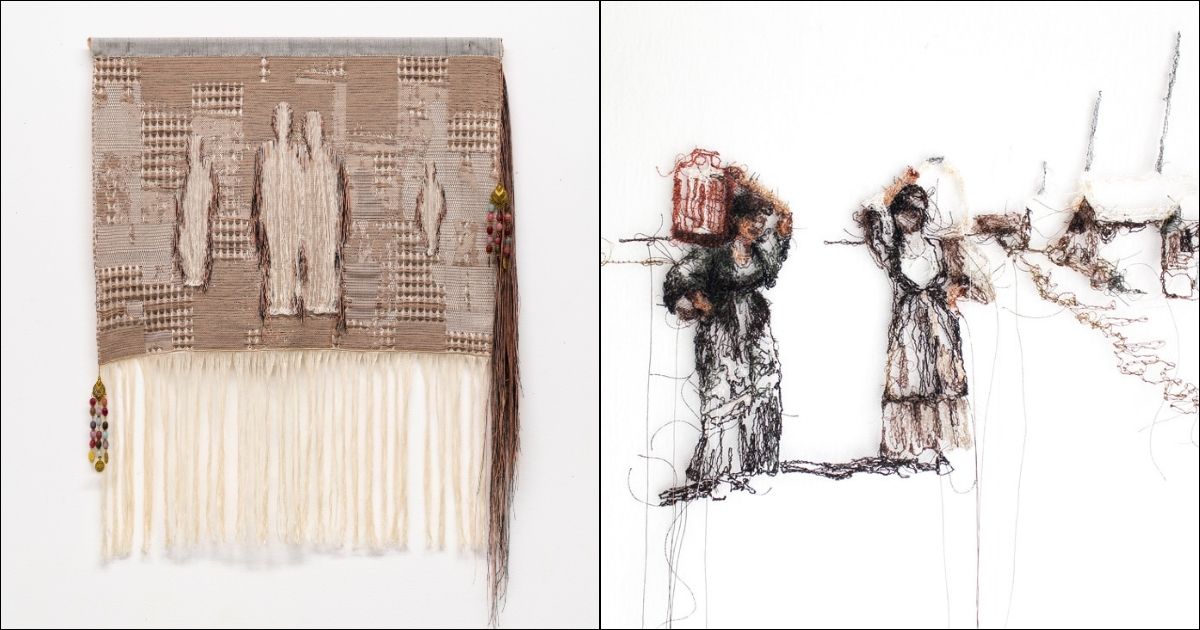
Left: whispers in the warp. Right: Some Things Forgotten.
- What challenges have you faced as a diasporic artist?
- One big challenge is just the reality of being an artist today, especially as someone from an immigrant background. I'm one of seven kids, and most of my siblings are in more financially stable careers. Being an artist is a privilege in many ways. It requires a lot of dedication, and it can be hard to stand firm in that identity when you come from a family that’s just trying to survive.
- There’s also the challenge of working with archives; so many gaps, so much you don’t have access to. That can feel isolating. But the beauty is that you also form new connections and new communities through your work. That’s hopeful.
- What are the main messages or ideas that you hope people take away from your work?
- I hope people reflect on the experiences of their neighbors, whoever their neighbor might be. Displacement takes many forms: war, environmental disasters, gentrification. It disrupts generations. My work is an invitation to think about those disruptions and how they exist in the spaces we live in.
- What do you hope for the future of Kurdish art and Kurdish artists?
- I struggle with how the West categorizes art: capital A "Art" versus craft or folk art. I truly believe that art is everywhere and everyone is an artist. I hope we don’t lose our forms of art, especially in handicrafts. That’s why I’m so dedicated to this medium; there’s so much ancestral knowledge in it.
- I hope Kurdish artists keep creating, even in small moments. Making with your hands is healing, grounding, and a beautiful way to build community.