
Art and Culture: Dara Aram

"The artistic process isn’t just about creating something visually interesting; it’s about the responsibility you take on when you decide to represent a community’s pain, joy, and history."
Dara Aram’s art begins with a life shaped by exile. Born in Sulaymaniyah in the Kurdistan Region of Iraq, he trained as a young artist before political upheaval forced him to leave. In this interview, Aram retraces the escape that carried him across borders and through uncertainty, traveling through Iran, Syria, and Türkiye before reaching the Canadian Embassy and resettling in Canada in 1989.
In this interview, Aram retraces the escape that carried him across borders and through uncertainty, traveling through Iran, Syria, and Türkiye before reaching the Canadian Embassy and resettling in Canada in 1989. He speaks about what it means to survive persecution, rebuild a life, and keep creating when your identity is treated as a threat.
That history sits at the center of his mixed-media practice. Aram describes how Kurdish cultural references, personal memory, and the Canadian landscape come together in work that is both intimate and political. He discusses the responsibility he feels to address the Kurdish struggle, and why he believes art can do what policy debates and news cycles often cannot: make viewers feel the human cost of statelessness, repression, and displacement.
The conversation also turns to the realities of being a Kurdish artist in diaspora, including community tensions, pressure to stay silent, and the risks of speaking publicly. Aram reflects on why he continues to make work that names injustice, including his response to Kurdish issues and events such as the death of Kurdish girl Jina Amini in Iran. Across it all, he returns to a steady purpose: to protect memory, insist on visibility, and create images that invite understanding beyond borders.
- To start off, could you tell me about yourself?
- I’m Dara, a visual artist and a Kurdish-Canadian. I was born in Slemani, in the southern part of Kurdistan. I studied at the Institute of Fine Arts in Slemani from 1980 to 1985. Unfortunately, I couldn’t complete my degree because I had to escape into the mountains and later went to Sharbazher. From there, I went to Iran, crossed into Syria, then Turkey, and eventually was accepted by the Canadian Embassy in Ankara. I’ve been in Canada since 1989.
- I studied at the Ontario College of Art, which is now part of the University of Toronto. I didn’t pursue a degree there either since I was more interested in gaining experience. Since then, I’ve participated in over 115 exhibitions around the world, and I’ve taught and lectured, including at Ryerson University, where I spoke on art and politics.
- My art practice has two primary focuses. One is political, rooted in my background and experiences. The other is more personal; an exploration of my own style, combining elements of Kurdish culture with Canadian landscapes. My work blends past and present, and I use mixed media, thick paint, gel, and pens to express myself. Art is the only way I can fully exist and bring memory into the present.
- How did you find your current style?
- It’s funny because I never saw myself as an artist at first, I was actually a handball player for Kurdistan. When I started at the Institute of Fine Arts, some of the teachers made fun of me, saying "he's not an artist. Why doesn't he go follow his dream as an athlete?” But over time, I realized that art was how I could express who I am. As a person, you have to show your identity. My art is to show my existence, who I am as a person. That’s why I jumped into art.
- I still don’t call myself an artist. I’m just experimenting and doing my own thing. Many of my classmates were much better artists, but most of them stopped creating. I kept going because I believe in what I’m doing. I’ll keep working until my last breath.
- How did you come to develop those two distinct threads in your work—the political and the personal?
- You can’t avoid politics when you come from where I come from. The persecution of Kurds in Iran, Iraq, Syria, and Turkey, it’s like an earthquake that constantly shakes you. You have to express yourself and show your audience. It’s a personal obligation to show this in my work. No one is forcing me; it’s in my blood.
- At the same time, my daily work is about evolving as an artist, exploring new ideas and styles. But being Kurdish means your identity is always tied to politics. I wish I could be someone who grew up in Canada with no ties to conflict, but that’s not my reality.
-
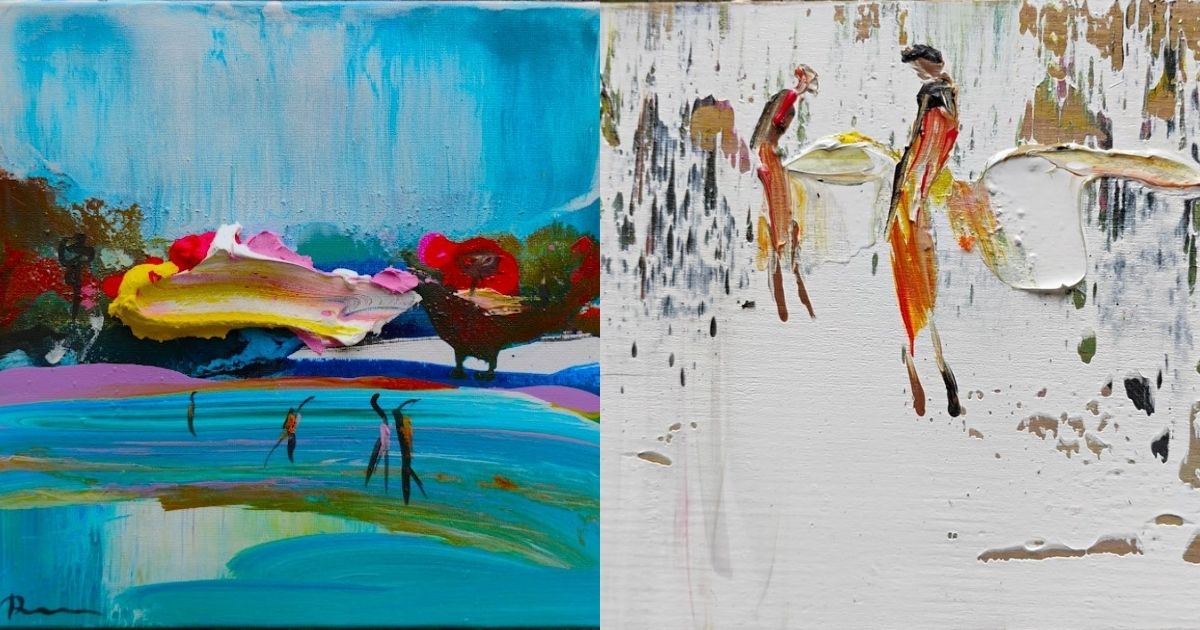
Left: Peaceful Haven No. 5, 11, 12. Right: Humanity And Nature.
- How did you begin painting landscapes, especially those inspired by Canada?
- When I was young in Kurdistan, I had vivid memories of my mother and sisters. My mother has passed, but those memories live on. Now in Canada, I travel across Ontario, and the landscapes here inspire me deeply. I often blend the beauty of Canada with memories of Kurdish villages: places bombed, people killed. The figures of women, of my mother and sisters, often show up in these scenes.
- What have you discovered through this blending of Kurdish memory and Canadian environment?
- It’s an ongoing journey. Canadian audiences tend to accept and even embrace the disturbing images I create. I distort reality in my landscapes, and each new painting brings a new idea. The process never stops since it’s always coming into my head.
- As a diasporic artist, how has your Kurdish identity shaped the way your work is received in Canada?
- Canada is multicultural, so people often connect with the themes of origin and identity. Many Canadians own my work and appreciate how I bring two worlds together. My art doesn’t just belong to one group or to Canadians, it belongs to anyone. Over time, as I’ve exhibited more in places like Toronto and Hamilton, more people have accepted and collected my art.
- What challenges have you faced due to your identity or the political nature of your work?
- The challenge I face is seeing all the negative news about the Kurds, and it has a bad impact. Sometimes I wonder, why do I have to be a Kurdish guy? The constant conflict, the problems, and the so-called peace process that I don’t believe in, it all takes a toll, even on my artwork. People worldwide, especially in Canada, love the Kurds and support our self-determination, but when our people don't even like each other, it’s hard to stay positive. Sometimes I wish I could be from a different ethnic group, one where the people are united against persecution, instead of fighting each other. It impacts intellectuals, artists, and anyone thinking about identity. I remember in 1997, when I had a show, I invited Kurdish politicians, but on TV, they were showing Kurds fighting each other. It was really painful, and it had a negative impact on me, especially as an artist. Still, I see myself as a Kurdish nationalist, even though I’ve lived away from the region for decades.
-
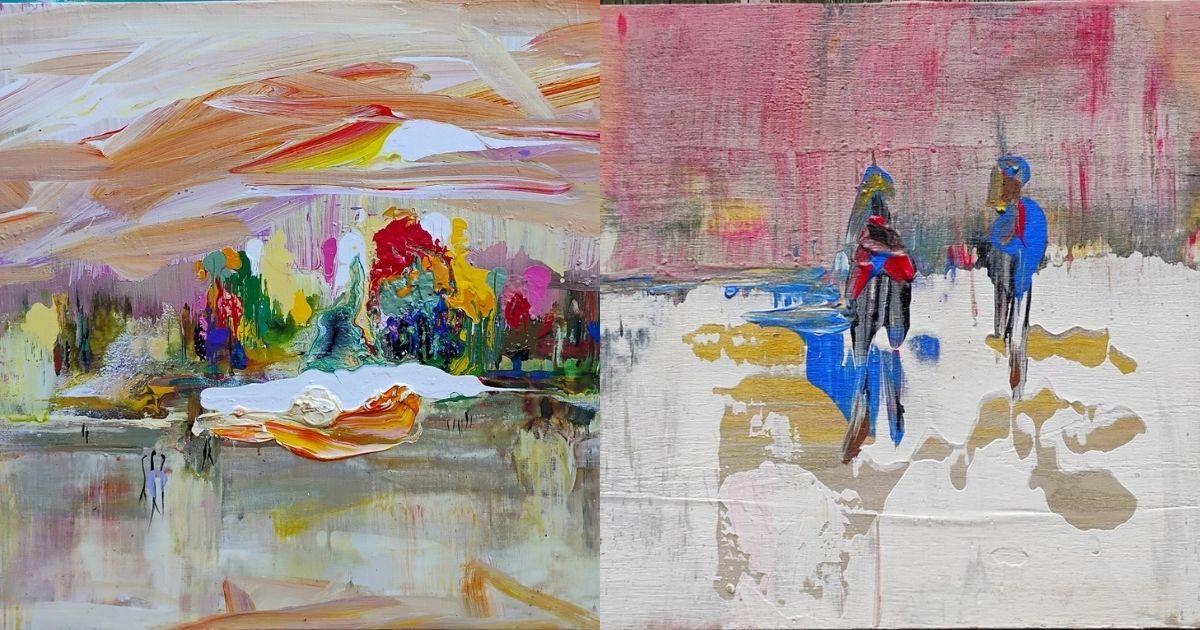
Left: Touched Forest No. 4. Right: Humanity And Nature.
- What do you hope for the future of Kurdish artists and Kurdish art?
- There’s potential, especially among the diaspora. But we need stronger community support. In the past, organizations like KNC and channels like Medya TV supported artists. That kind of support has faded. Communities that invest in their artists, like the Armenian community, help those artists thrive. Kurds abroad need to do more.
- What do you hope people take away from your work?
- I want people to understand who the Kurds are: a large ethnic group without a state. I want to educate, not advertise. For instance, I’ve worked on pieces about Jina Amini and others who were killed. Many people don’t know these stories. My art is about raising awareness.
- What advice do you have for people who see your work and want to support Kurdish art or the Kurdish cause?
- Art speaks from the heart, and people are more likely to listen to an artist than a politician. I hope people respond positively and seek out more knowledge. The Middle East doesn't always welcome this kind of work, but here in Canada, especially after 1991, there’s been a lot of support for Kurdish voices. Art can be a powerful tool for education and change.