
Art and Culture: Kani Kamil

“I want viewers to come away with questions about themselves, about the systems they participate in, and about the narratives they've accepted as truth. If my work can create even a moment of critical reflection or emotional resonance, then it’s done its job.”
Kani Kamil lives and works in London, where she creates bold visual art and experimental sound performances grounded in feminist and decolonial ideas. Born in Slemani in the Kurdistan Region of Iraq, she grew up surrounded by music—an upbringing that tuned her ear to rhythm, emotion, and storytelling. Today, her work weaves together memory, resistance, and identity, mining both personal keepsakes and political archives to bring overlooked Kurdish histories into view.
In our conversation, Kani traces her journey from childhood collages in Kurdistan and the rigid art curriculum she found stifling, to the freedom and critical dialogue she discovered during her MA under Sonia Boyce.
Now pursuing a PhD, she speaks openly about the bittersweet loss of her early creations and the ongoing challenge of defining herself as a diasporic artist. Whether through live performance, film, textiles, hair, or archival installations, Kani invites us to question familiar narratives and listen closely to the stories—especially those of Kurdish women—that have too often gone unheard.
- Can you begin by telling me about yourself?
- I’m a Kurdish artist and researcher, originally from Slemani in the Kurdistan Region of Iraq, where I was born into a family of musicians. Growing up in that creative environment had a big influence on me, it taught me to listen closely, to feel rhythm and emotion, and to see art as something that naturally flows through daily life. Today, I live and work in London, where I continue to develop my practice through research, exhibitions, and collaborative projects.
- My work is deeply rooted in feminist and decolonial approaches, often drawing on personal, political, and archival material, especially from underrepresented or silenced narratives within Kurdish history. I’m particularly interested in the intersection of art, memory, and resistance, and much of my recent work has focused on activating hidden or forgotten archives through performance and visual storytelling.
- Outside of my practice, I spend a lot of time attending exhibitions, talks, and events around London, staying connected to the wider art scene and constantly learning from what’s happening around me. Art is also at the heart of my home life. My husband is an artist, and my daughter is studying art history, so our home is often like an ongoing seminar, full of lively conversations, feedback sessions, and shared ideas. It’s a space where creativity and critical thinking are always in motion, and I really value how much we inspire and challenge each other.
- Could you describe your artistic journey?
- My artistic journey began organically, I was always creating as a child, making collages from whatever I could find. In the early 2000s, I studied traditional art forms in Slemani, focusing on ceramics. The program was limited, rooted in outdated approaches that left little space for experimentation or critical engagement. I often felt constrained by the rigid structure, but even when I was influenced by it, I never fully accepted its frame. I was always trying to push beyond the boundaries it imposed, and that desire for freedom in my practice became a defining force.
- That inner drive to work beyond limitations eventually led me to seek new perspectives and opportunities beyond Slemani. After graduating, I received a scholarship to study abroad and began my MA in Fine Art at Middlesex University in London. There, under the mentorship of artist Sonia Boyce, my practice began to shift, encouraging me to reflect more deeply on identity, experience, and the political dimensions of my work. Immersed in London’s fast-paced and diverse art scene, I was challenged to find my voice among many. This process of adaptation and self-discovery shaped a practice rooted in research and storytelling, with a strong feminist perspective and a growing focus on performance, video, textile, and archival material.
- Looking back, I can see how every phase, from those first childhood collages, through the limitations of traditional study in Slemani, to the freedom and critical dialogue I found in London, has added a layer to my voice as an artist and researcher.
-
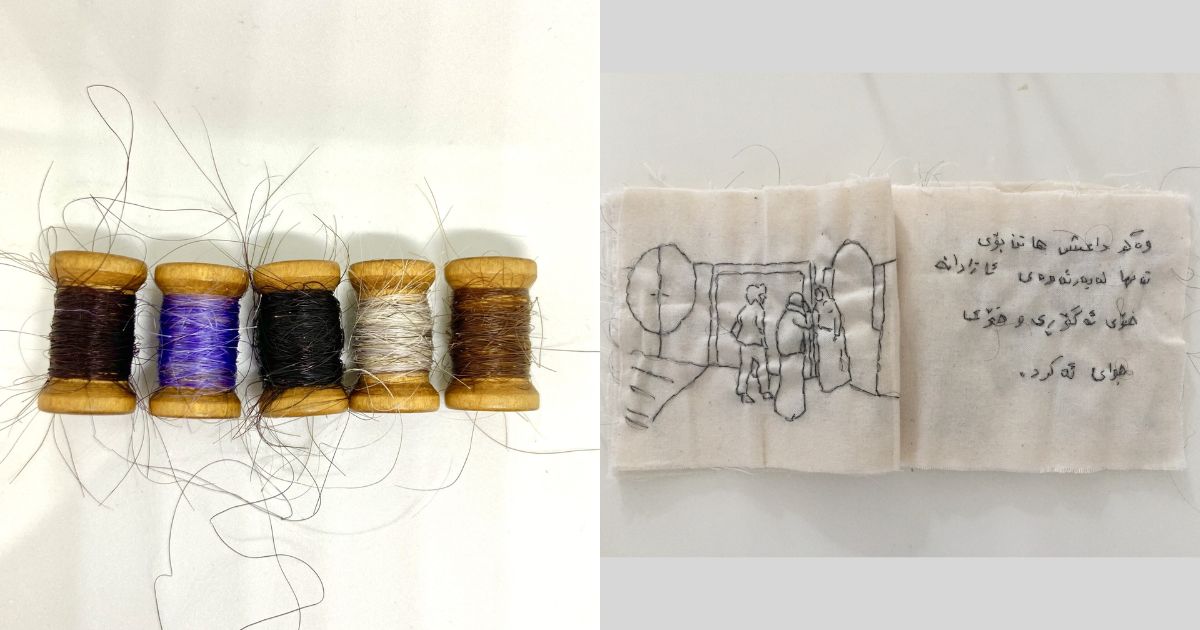
Left: My Hair Diary. Right: Handmade Book, Kurdish Writing with Human Hair on Linen.
- Where do you draw inspiration from?
- Inspiration, for me, has always come from a deep, almost instinctive sense that I see the world differently, that I question things others might take for granted. Even as a child, I was curious about structures of power, especially around gender. I remember asking my mother endless questions about the role of women in our society and the systems that limited their freedom. That early awareness of inequality stayed with me.
- As a girl, I was constantly creating, making objects, drawings, collages, even writing short stories. But none of those works were saved. They were lost over time, and that loss left a deep mark on me. That absence has made me think deeply about the act of archiving, how easily stories, especially those of women and girls, can disappear if they aren’t preserved. It’s part of what drives my work today: the need to make visible what has been hidden, to surface the untold, and to create space for stories that have been silenced by cultural norms and patriarchy.
- So much of my inspiration comes from this urge to hold onto memory, to critique systems of power, and to transform personal and collective histories into something that can be seen, heard, and remembered.
- How has your Kurdish identity impacted your life and work?
- My Kurdish identity is at the core of who I am, and it inevitably shapes my artistic practice. One of the biggest challenges I face is the absence of a well-established Kurdish art community in the diaspora. Without that infrastructure, gaining recognition as a Kurdish artist can be incredibly difficult. We often have to navigate other cultural spaces just to be seen or heard, which adds another layer of complexity to our journey.
- But this challenge also becomes a creative drive. My identity gives me a deep well of subject matter to explore, especially around language. Living in the UK, I’ve become increasingly interested in how language functions not only as a means of communication but also as a tool of power, repression, and resistance. Thinkers like Frantz Fanon and Susan Buck-Morss discuss how colonization often works by erasing or fragmenting native languages, which can lead to the loss of entire cultures. In this context, translating forgotten or suppressed voices through art becomes an act of cross-cultural understanding and survival.
-
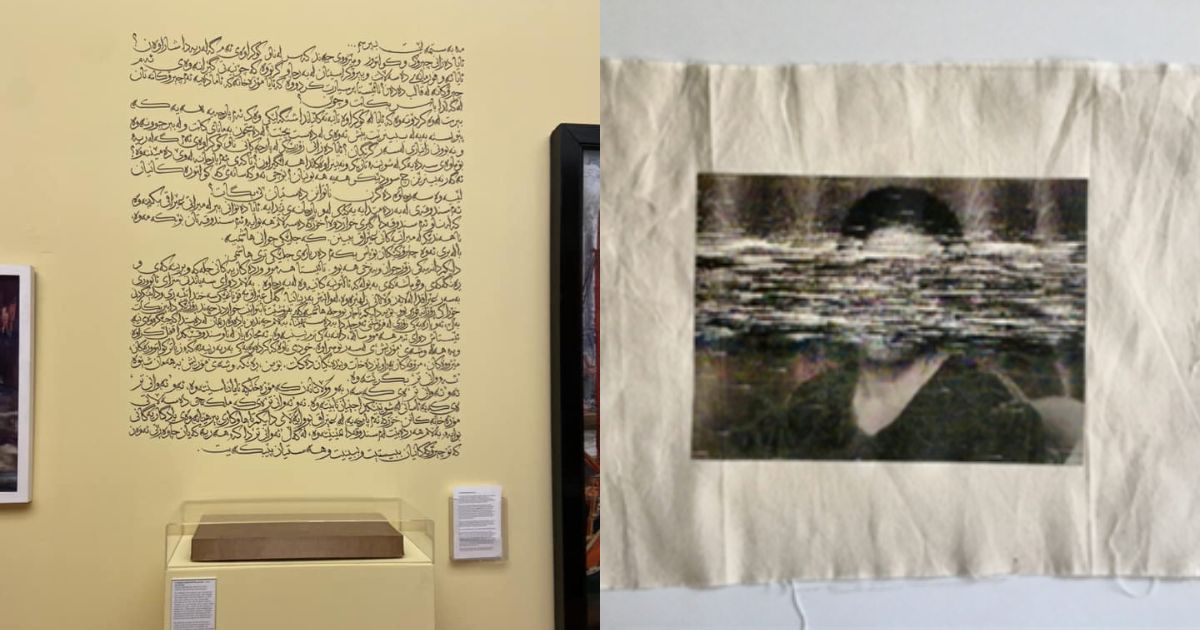
Left: Whisper Behind the Grand Tour. Right: Defaced faces.
- What challenges have you faced as a Kurdish artist?
- Being a Kurdish woman gives me a deep sense of pride and strength. I draw a lot of empowerment from the achievements of Kurdish women, despite the intense pressures of living within a deeply patriarchal system. Many have shown incredible resilience, courage, and leadership. However, one of the biggest challenges is having these stories recognized beyond our own communities. So often, women from the Middle East are portrayed only as victims, without acknowledging the complexity, power, and success that also exist within our experiences.
- Much of my work as an artist is about challenging that narrative, about pushing back against the silence and making space for Kurdish women’s voices and histories that have rarely been documented or acknowledged. It’s frustrating that in the West, people are quick to point out oppression in non-Western cultures, while often ignoring the systems of patriarchy and inequality that exist within their own.
- For me, it’s important to challenge these double standards and make it clear that gender-based oppression is a global issue. We need to stand together, across cultures, to fight patriarchy as a shared struggle and to amplify the stories that have long been overlooked.
- What messages or ideas do you hope people take away from your work?
- At its core, my work is an invitation to pause, to question, and to unlearn. I often use simple visual languages to disrupt what feels familiar or normal within my culture. It's a deliberate way of drawing attention to everyday norms and structures that we have internalized and accepted, yet deserve to be interrogated. Whether it's gender roles, language hierarchies, or inherited notions of identity, I'm interested in gently yet persistently challenging the status quo.
- Ultimately, my aim is not only to create aesthetically engaging work but to contribute to broader conversations around identity, cultural memory, and the possibilities of resistance through artistic expression. I want viewers to come away with questions about themselves, about the systems they participate in, and about the narratives they've accepted as truth. If my work can create even a moment of critical reflection or emotional resonance, then it’s done its job.