
Art and Culture: Khadija Baker

“We are living archives. Memory shapes who we are—it’s the essence of our identity. What we carry from the past makes us more than just our present selves.”
Khadija Baker, a Montréal-based interdisciplinary artist originally from Kurdish Syria, creates immersive installations that weave together memory, displacement, and identity. A core member of the Centre for Oral History & Digital Storytelling, her work bridges personal trauma and collective history through textiles, sound, sculpture, and participatory performance.
In this interview with the Global Kurdish Initiative for Peace, Baker opens up about how memory and oral storytelling—rooted in her Kurdish heritage—shape her art as acts of resistance and healing.
Baker brings attention to the quiet, powerful forms of defiance carried out in everyday life, especially by women: through cooking, embroidery, and caregiving. She reflects on the enduring impacts of colonialism and emphasizes the need for community-based art as a path toward social and environmental justice.
With a deep belief in the strength of shared experiences, she calls for more inclusive, supportive spaces where Kurdish artists—and marginalized voices everywhere—can thrive, connect, and be heard.
- Could you begin by telling me about yourself?
- My name is Khadija Baker. In Kurdish, my name is Xece, but we were not allowed to use our Kurdish names. I’ve been in Canada for over 20 years. I came as a refugee and later became a citizen. I’m now well-integrated here—as a mother raising my kids and as a full-time interdisciplinary artist.
- In my work, I focus on oral history and social issues, often highlighting how politics affects our lives. This comes from personal experience, but I recognize it’s not just my own—it reflects many shared realities.
- I don’t like to put myself in a box, but I align with feminist ways of working—as revolutionary, as protest, and as a form of advocating for human rights across race, gender, and through community-based practice.
- For me, art is not only resistance—it’s also a way to reform the social context. I see it as a means of reshaping the society around us by actively engaging with individuals and communities. It has strengthened me, and if it can do that for me, I believe it can do the same for others.
- How did you begin your artistic journey?
- I come from a conservative social background. As Kurds, especially in the small town I grew up in—maybe 50,000 to 60,000 people at the time—art wasn’t something people really appreciated.
- But I always loved art, and I’ve been doing it since I was a child. I used whatever I could find to make paintings and drawings, even though we didn’t have proper materials. I painted on walls, in the kitchen, in the garden—anywhere I could. My neighbors loved it, and my mother loved it, so I kept going.
- Eventually, it started to expand—onto pillows, around the house, even onto clothing. I would make paintings with my brother, and with the support of my sisters and brothers, I was finally able to study Fine Art.
- When did you become interested in experimentation with art forms?
- I didn’t do much in Syria beyond classical oil painting. I loved to experiment, but always within traditional styles. At the time, painting and drawing were considered the only legitimate forms of art. There were very few galleries in Damascus—and almost none elsewhere—and most served the regime’s interests.
- It wasn’t until I came here to study that I discovered new possibilities. I began with painting and drawing but moved into open media because I was drawn to working with space and exploring how time and space could shape my work. I also had stories to tell—real voices I wanted to include—so I began collecting them and working directly with people. I later learned this was called oral history.
- For me, oral storytelling was already part of my culture. Without access to our language, we as Kurds used orality to preserve our stories and daily practices. I realized that practicing what had been suppressed wasn’t just resistance—it was a form of preservation. That’s when I found my direction: using oral history as both community practice and artistic method.
- Many marginalized communities use oral history to resist erasure and hold onto identity. I saw its power, and I’ve continued to explore it as a vital tool in my art.
-
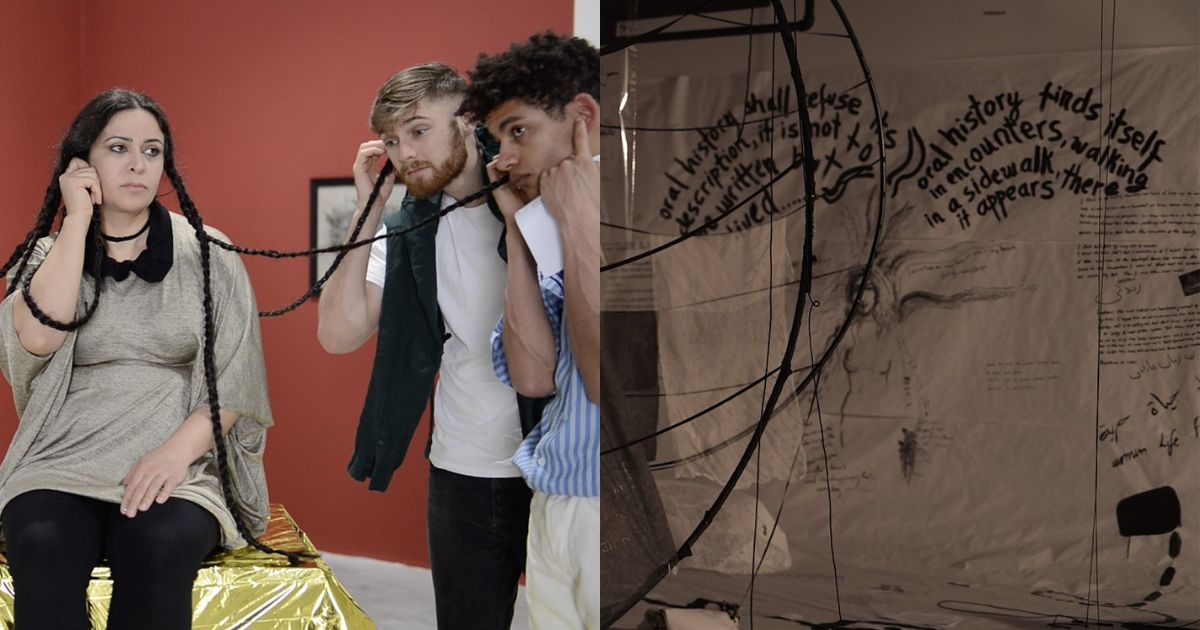
Left: Personal Revolutions: my little voice can't lie. Right: book room.
- What advice do you have for people who wish to support and engage with your art?
- To give a chance for self-expression is the way you give a chance for basic human rights. You cannot give something to somebody—they have to take it. If I am resisting, I have to take action, and we need to support this kind of action-taking.
- If you give a person freedom, they will always think it’s given to them, and they will be in victim mode. To empower them, bring their voices forward and let their voices be. Open a space—or let them open the space—they wish to be in. If they grow, let them grow the way they wish.
- We don’t always need to take a path that was already there. We can always allow exploration. I can tell a person, “Come, follow this path, you’ll arrive at a safe place.” No—let the person choose which path they want to go on, whether they wish to go to the place you want them to be, or if they want to explore a new place.
- This way, it enriches the life we have, rather than just taking everybody to the place we know. These openings are a way for people who are underrepresented, or people who are suppressed by different forms of power—let’s say based on color or gender.
- It’s important to let people explore their own way, and we should respect their choices just as we respect our own.
- How have history and memory inspired your work?
- We are living archives. Memory shapes who we are—it’s the essence of our identity. What we carry from the past makes us more than just our present selves.
- For me, memory is deeply connected to oral history. Both are alive, personal, and communal. A story told by my grandmother carries her voice and perspective. When I pass it to my children, it carries mine. Memory doesn’t die—it evolves across generations.
- We are constantly changing. Every book we read or piece of art we create transforms us. Growth comes through experience, and that insight enriches who we are.
- I remember eating my mother’s food after years apart—it didn’t taste the same. That’s because memory is alive; we chase feelings, not just flavors. I teach others to respect memory, but also to find joy in the present.
- It’s important to find strength in new experiences, to feel a sense of belonging where you are. If we stay stuck in the past, we lose connection to the present. You can’t live in memory alone—you have to root yourself in your current environment.
- How have your Kurdish and Syrian identities evolved as you’ve explored memory and oral history?
- It’s important to consider where someone comes from and the experiences that shape them. My identity as a Syrian and a Kurd was the foundation of who I am, but I wasn’t the same person when I first arrived in Canada.
- In Syria, I was a minority—and that didn’t change here. Being a minority stays with you, and over time, I began to see how deeply politics shapes daily life. I questioned why people still have to fight for basic rights, like language. Eventually, I understood how colonial systems use power to erase or control minorities, shaping narratives and spaces to serve their own agendas.
- This led me to reflect on how our names and languages were forbidden, how maps and populations were altered. These realizations began surfacing in my art and became part of my healing. I saw how colonialism isn’t just territorial—it’s also a mentality, one that enforces patriarchal and racial hierarchies. That’s when I truly began to understand the role identity plays in all of this.
- With time, the question of belonging became central, especially after having children. Life in Canada is very individual—so different from the communal culture I came from. At first, it was jarring to say hello and be ignored.
- Later, I found a different kind of connection—through the land. Planting in my backyard helped me learn the weather, the soil, native plants, and even pests. It gave me a deeper sense of place. Seeing climate change in my own garden grounded me in a new way. It became another form of belonging—rooted in everyday life.
-
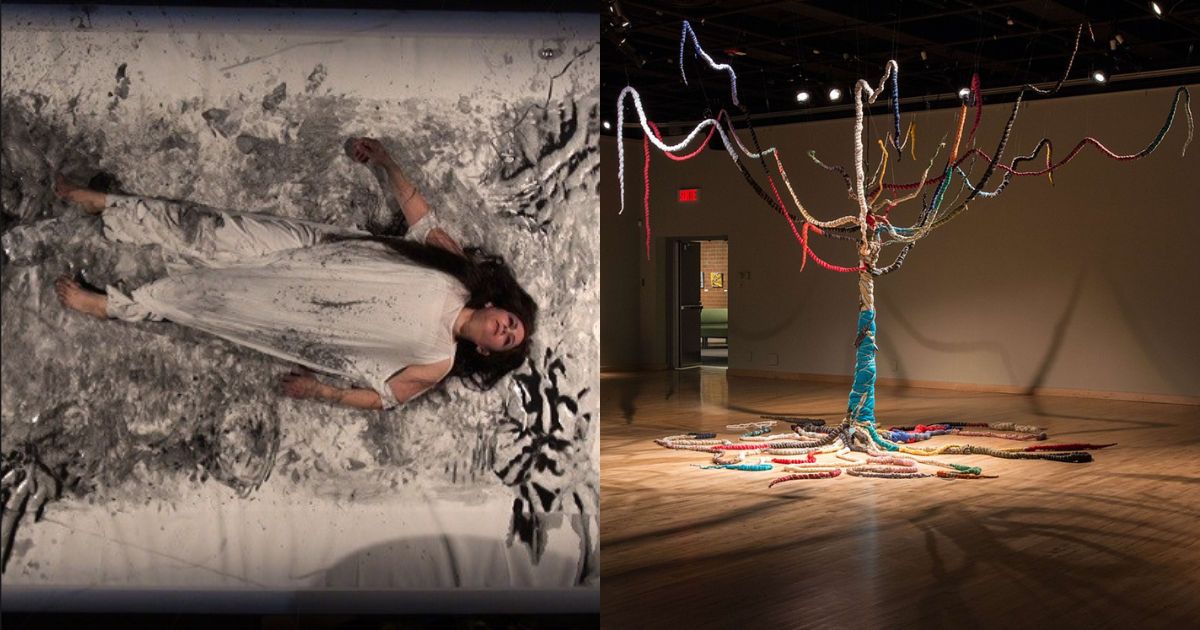
Left: “Don’t leave me... I am alive.” Right: Racine/Roots.
- How has your Kurdish identity impacted your work and where do you draw inspiration from?
- I’ve learned a lot from my Kurdish identity—it’s complex, but it’s something I’ve always been proud of: my language, my culture, the way I grew up. It’s not about nationalism; it’s about community. I was born into a Kurdish community and having that appreciation for your roots is important. It’s a seed—it shapes who you are.
- Then comes the question: how do you belong to the world? I’ve realized that I’m part of a larger whole. The divisions between communities are mostly artificial. Borders may exist on maps, but in real life, they’re just wires or walls. People still move, exchange, fall in love—regardless of language or culture. To live, you must coexist. Identity isn’t just one body or one culture; it’s also about how you relate to others.
- With that understanding, it’s important to reflect on who you are now and how your identity evolves. During the Syrian war, I was disappointed when someone said, “Let’s celebrate you because you’re Kurdish and Kobani was freed—because you’re a Kurdish female artist,” as if our strength only came from carrying weapons. But we were always strong. My grandmother, in my eyes, was as strong as any soldier—and she never held a weapon.
- That kind of thinking still persists, and it’s something I challenge through my work. We need to recognize both the visible and quiet acts of strength in life—as ways of preserving the self and surviving. When you live through violence or oppression, acknowledging it is how you reclaim your power. It doesn’t belong to anyone else.
- That’s what identity means to me now. I belong deeply to this place, and in that belonging, I preserve my roots. Without them, I wouldn’t be who I am.
- Could you share more about what you're currently working on?
- I’m working on an experimental video about female resistance and empowerment. What frustrates me is how Kurdish female fighters were only recognized after carrying weapons in Kobani—as if their strength only mattered once it mirrored a male form of power. But they had been resisting and protecting their communities long before that.
- Women like my mother showed strength in daily life—through embroidery, food preservation, raising children, and working in the fields. This labor was economic, cultural, and essential, yet often dismissed. Even when a woman doesn’t work outside the home, her contributions are real and powerful.
- We need to recognize acts like fighting for education, choosing one’s partner, or deciding whether to wear the veil. These personal choices are major forms of resistance in patriarchal societies.
- When we only celebrate women for taking on traditionally male roles, we ignore the depth of their power. Why don’t we see the value in nurturing, cooking, creating, and choosing for oneself? These acts build families, preserve memory, and shape culture.
- My work celebrates all forms of women’s power—whether it’s cooking, dancing, or carrying a weapon when necessary. But real strength lies in choice—not just surviving, but deciding who you want to be. That, to me, is the most empowering act of all.
- What advice do you have for people who wish to support and engage with your art?
- Working with memory—especially difficult stories—is not easy. It’s hard on artists, and it was really hard on me. What helped me, and might help others, was finding collective spaces—gatherings where stories can be shared together.
- When you share something painful, others open up too. That collective sharing eases the weight of your own pain because it becomes a shared experience. It’s not just your burden, and it’s not just your community’s—it connects you to others.
- When I meet with Armenian, Iranian, Palestinian, or other communities, I feel a deep appreciation for the trust people place in one another to share their stories. It’s rarely easy to talk about painful things, but sharing helps—not by comparing pain, but by bringing it together. It creates support and invites deep listening.
- It’s important to find people who can truly listen, to connect and work collectively—especially with other artists navigating similar struggles. That connection is vital to continuing the work. Isolation is painful. It keeps you in the dark, in depression. But shared expression brings light.
- What final thoughts can you share?
- Culture is still struggling. Back home, there were almost no art spaces. I wish more were created—not just white-box galleries, but cultural houses and open community spaces—for the next generation to engage with art.
- Art empowers people. It helps them see and appreciate what’s often overlooked. Creating spaces that involve families and communities is essential—not to heal everything, but to support mental well-being and resilience.