
Art and Culture: Pedram Baldari

"I’m constantly grappling with how to represent my culture, history, and struggles without oversimplifying or exploiting the narrative. The artistic process isn’t just about creating something visually interesting, it’s about the responsibility you take on when you decide to represent a community’s pain, joy, and history."
Pedram Baldari is an interdisciplinary artist, architect, and scholar. Currently, he is an assistant professor at the University of Michigan’s Stamps School of Art and Design. His art explores issues of land and belonging, colonialism, displacement, conflict, and the way a culture of violence creates “reality.”
- Can you begin by telling me about yourself and your artistic journey?
- My name is Pedram Baldari. I am from eastern Kurdistan, the city of Sine (Sanandaj), which is the capital city of the Kurdistan province in Iran. I was born in 1981, right after the major civil uprising in Rojhalat against the newly emerged government in Tehran. My hometown, right before I was born, was the epicenter of a major conflict between the Kurdish Peshmerga and the central government because of the oppressive policies carried out by the government in Tehran.
- I came into this world questioning these harsh realities. My parents and grandparents helped us understand through storytelling what was going on. When I was a child, I didn’t fully grasp these complexities, but I knew that someone I loved was imprisoned or had suffered, and that sparked questions. At the same time, it was the beginning of the eight-year war between Iran and Iraq, which made Kurdistan a war zone. We were also affected by Saddam Hussein’s genocide of the Kurds in southern Kurdistan. As a child, I learned practical survival skills, like where to go when the radio alarm would sound during airstrikes.
- Despite all this turmoil, I grew up focused on learning and going to school. Eventually, I chose to study architecture at the university, despite my parents' wishes. There’s a national exam in Iran that determines where high school graduates can attend university, and I did very well on it. I chose architecture because I was tired of physics and mathematics and didn’t resonate with engineering in the traditional sense. I enrolled at Tehran University in the College of Arts and Architecture and Urban Planning.
- There, I became exposed to the art world and was particularly fascinated by visual art, conceptual art, and performance. As I pursued my architectural studies, I also began doing my own artistic exploration alongside it. After graduating, I worked as an architect in Tehran for a while, but I eventually decided to pursue graduate studies abroad, because I felt like I couldn’t fully express myself in Iran.
- I came to the United States as a student and went to graduate school, where I completed my studies in visual arts, focusing on interdisciplinary art. After finishing grad school, I became a fellow at the University of Minnesota and later became a lecturer. I worked my way up to a term assistant professor position and then a professor at the University of North Texas. Now, I’m an assistant professor at the University of Michigan at the Stamps School of Art and Design, while continuing to make art and explore other disciplines.
- How do you view art and how do different disciplines come together in your practice?
- I approach art as a kind of cross-section between various disciplines. For me, art is not confined to a specific medium or form; it can span from social sciences to sound engineering, data science, and even beyond. These disciplines serve as materials for my artistic practice. I think about these fields as modes of inquiry. So in my work, materials can be anything, whether it’s social issues, scientific research, or even technology. I see them as tools that support the creative process, but they don’t define what must happen in the project.
- Artistic projects can exist across various forms, and they don’t need to fit neatly into one category. For example, an artistic project could simultaneously be a social practice and a scientific research project. This flexibility allows me to approach problems from different angles and think more holistically about how art interacts with the world. I’m constantly grappling with how to represent my culture, history, and struggles without oversimplifying or exploiting the narrative. The artistic process isn’t just about creating something visually interesting, it’s about the responsibility you take on when you decide to represent a community’s pain, joy, and history. This has become a central part of how I approach my work today.
-
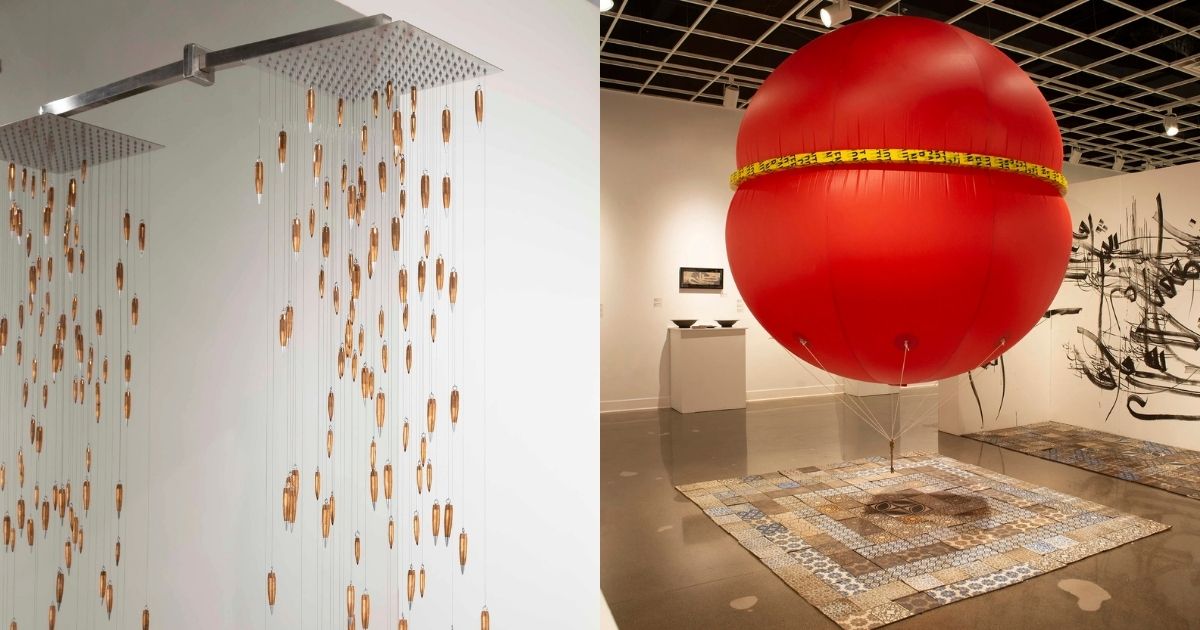
Left: This is the Real Shower. Right: Love Note to Liberty.
- How did different mediums and tools help you unpack your own personal history?
- For years, approaching the Kurdish issues was extremely painful for me because it's a first-hand, embodied experience. I couldn't put on my analytical hat when I talked about things I had first-hand experience with. I was trying to talk about works that, as a kid, I couldn’t even start without bursting into tears. Imagine doing academic talks or artist talks, and it’s impossible to even begin without being overwhelmed emotionally. I kind of needed some distance from it, and these types of approaches allowed me to find that.
- What also helped me was seeing how other people, non-Kurdish people with similar histories or experiences, process and create work. This was valuable in allowing me to understand how to digest my own issues. I collaborated with Indigenous Anishinaabe cultural institutions, tribal members, and artists. For example, I worked with them on their struggles with oil pipelines crossing the treaty lands in the Great Lakes region. This collaboration allowed me to approach my own history with a bit more clarity.
- I believe in what I call a "second nature" approach to artistic production. It’s about digesting material, be it history, folklore, craft, socio-politics, or theories in aesthetics and social theory, and allowing it to settle and become second nature. This way, when I begin to create, it doesn’t feel forced. It doesn't feel haphazard or synthetic. It feels natural.
- Once I started creating from that perspective, I also began exploring the notion of liberty in Kurdish work. I remember creating a large-scale installation titled Love Not to Liberty. It featured a 10-foot-diameter red balloon filled with helium, choked by a ring made of caution tape. The balloon was carrying a ceremonial key to the Statue of Liberty, issued by New York in 1925. Behind it, there is a calligraphy of Sherko Bekas’s poem the Wall, that is about a wall in a city who is ashamed of itself because they have covered it with false political slogans.
- The balloon had a valve designed to slowly deflate over the exhibition period, symbolizing the ongoing, tragic cycle of Kurdish aspiration for liberty. The balloon would deflate enough to drop the choking ring, symbolizing the struggle for freedom and the broken promises tied to a century of Kurdish suffering post-Sykes-Picot treaty. The work was tragic, but it pointed to that reality in a meaningful way.
- What was your experience making your piece, The Heart of a Mountain?
- It's a land art, situated on top the mountain by the ruins of the ancient village in Hawraman Takht under a Qaswan tree, which is sacred to many Kurds. This is not an exhibition space; it's not a museum, and there’s no monetary benefit for me. I decided to make it open-source so anyone can access it directly on YouTube. It's not something locked behind a code or restricted access. The documentation is mostly a video, with my own voice providing context for people who might not be familiar with the location. I start with the question, What is the heart of a mountain? If a mountain had a heart, what would be in it?
- The work takes you into a part of reality that's painful, not easy to face. It’s historic, ancient, and simultaneously contemporary, layered with colonization, occupation, genocide, but also hope, love, and collective creative energy. The Kurdish women weaving Kurdish cloth or making shoes, it's a form of continuous stewardship of the land and facing challenges. The heart of the mountain, to me, is the people. It's the human and the non-human—the animals, trees, and water—but also the histories.
- I really love this myth about the mountains: When God creates the mountains, the mountain says, “I feel alone, up here by myself,” and God responds by creating the Kurds.
-
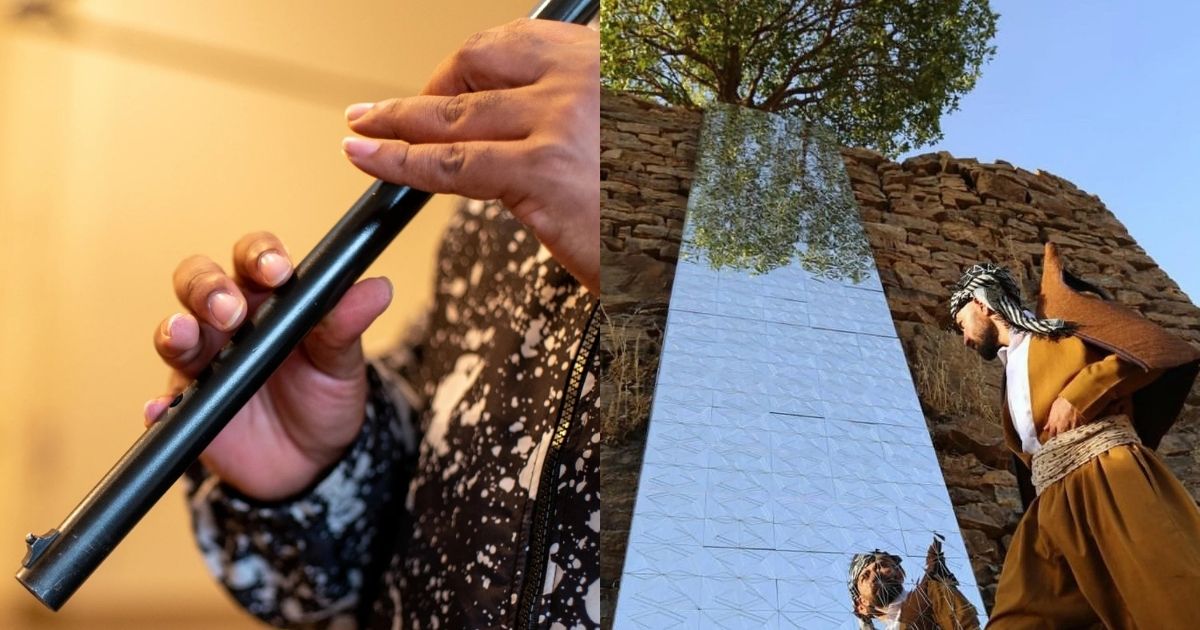
Left: Variations of Sounds, Traveling Between a Barrel and a Heart. Right: The Heart of a Mountain.
- What do you hope that people take away from your art?
- I hope people learn a little bit about Kurdish history and culture. I hope they begin questioning the dominant narratives. The region has long been subjected to cultural erasure, but Kurds have resisted this. They’ve created their own forms of artistic and cultural production, despite the barriers. It's like, you can't stop the flow of water forever. You can’t stop Kurdish people from aspiring to exist, to create, to flourish.
- There's also this insecurity about giving Kurds credit. When you give people the recognition they deserve, there’s less to fight over. We can finally have peace, sustainable development, and a brighter future. We need to push for this recognition and create a better future. Everyone deserves it.