
Art and Culture: Vian Hussein

"I don’t create from theory. I create from lived experience. My Kurdish identity is not something I add to my work; it is the foundation it grows from."
As a child in Western Kurdistan (Rojava), Vian Hussein watched buildings crumble around her. Now, she reconstructs them, not as monuments to destruction, but as testimony to survival. This Kurdish refugee artist transforms the fragments of war into hauntingly beautiful sculptures, paintings, and textiles that refuse to let memory disappear.
Vian did not learn about art in galleries. She learned from women who stitched stories into fabric and shared their culture through their hands. "At the time, I didn't think of it as art," she admits. "It was just life." After she had to leave home, she realized how quickly memories can fade. Art became her way to hold on to them.
Her figures often walk away, their backs turned. They are anonymous but still feel personal, inviting people to connect with the shared experience of migration and loss. In Manchester, young people saw their own struggles in her abstract art, showing that Kurdish stories can speak to everyone.
"When politics cannot fix something," she says, "art can still speak."
- Can you begin by telling me about yourself?
- I’m a Kurdish artist working with painting, sculpture, and textiles. My work comes from my lived experience of growing up with stories of war, displacement, and survival, as well as from strong women who carry culture through everyday acts like embroidery and storytelling. Art for me was never separate from life. It was always there in fabric, in patterns, in memory. Over time, I started using those elements in my own way, turning them into contemporary pieces that speak about identity, women, and what it means to exist politically as a Kurdish person.
- How did you get started in the arts? What has your journey been like?
- My artistic journey didn’t begin in a studio. It began at home. I grew up surrounded by women who stitched, repaired, told stories, and carried memories in their hands. At the time, I didn’t think of it as art. It was just life. As I got older, especially after experiencing displacement and political instability, I began to understand how fragile memory can be. I felt a responsibility to preserve what I had inherited, but in my own language. That’s when painting and sculpture became important to me. I began exploring destruction, identity, and women’s resistance through physical forms and materials. Over time, my work became more intentional and more political. I stopped trying to separate beauty from struggle. I realized that my practice sits in that tension between tradition and contemporary expression, between fragility and strength. My journey is still evolving, but it has always been about making sure our stories don’t disappear.
- How has your understanding of feminism evolved throughout your work?
- In the beginning, women appeared in my work instinctively. I was creating from what I knew: strong women, mothers, fighters, caretakers. Over time, I realized how central they were not only to my life but also to our history.
- Through my art, I came to understand feminism as lived experience rather than theory. Kurdish women have long carried culture and resistance, often without recognition. My focus shifted from portraying women as symbols of strength to showing them as complex political subjects, vulnerable, powerful, and real.
-
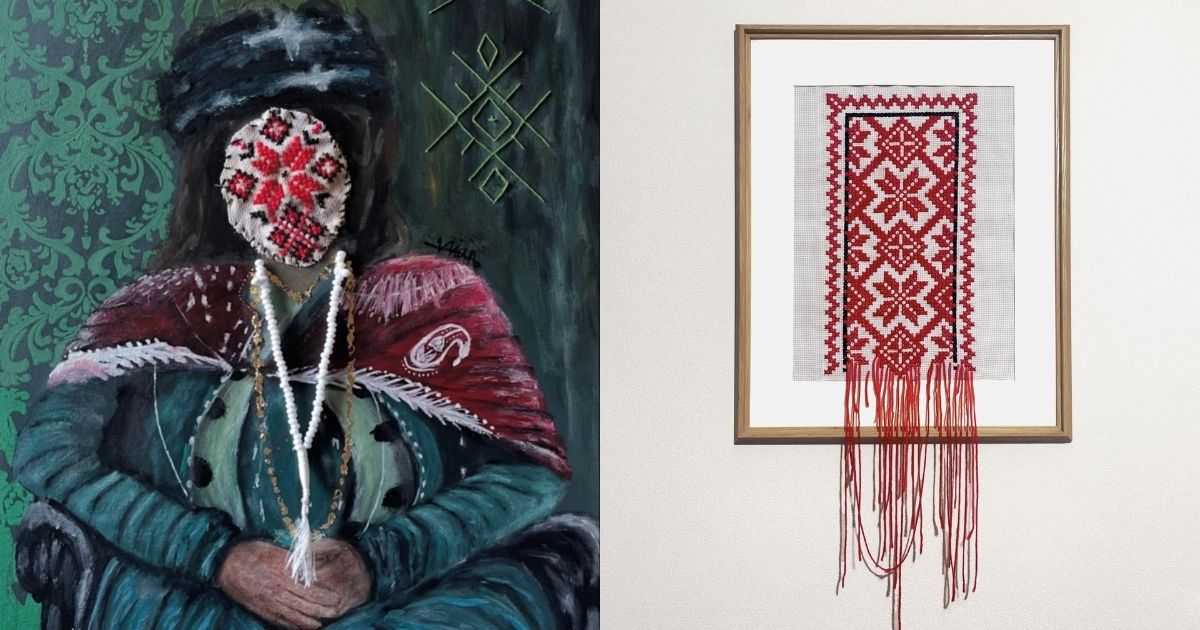
Left: Portraits of Kurdish Resistance: Adela Khanum. Right: Unravel.
- How did you draw inspiration when you transferred into new mediums like sculpture and painting?
- I am inspired by land, mountains, olive trees, and cities that have been destroyed and rebuilt. Places hold memories just like people do. Growing up in a politically unstable reality made me aware of how fragile identity and homeland can be, and that awareness constantly feeds my work. I am inspired by absence as much as presence, by what is missing, erased, or silenced. My art often begins in that space, trying to give form to something that cannot easily be spoken.
- As a child witnessing the destruction of buildings, I was inspired to create, in my graduation project, sculptures of destroyed buildings that represent the impact of war on the environment, urban areas, and human lives. War not only affects people; it affects everything around them. Because I was studying interior design and am now starting my master’s in architecture, sculpture became an exciting way to represent my journey.
- How do different mediums influence the subjects you examine?
- The mediums I work with are deeply connected to what I am trying to say. Embroidery comes directly from women’s traditions. It carries memory, care, and inheritance. When I use thread, it is intentional. It is not just material; it is history.
- Sculpture allows me to explore fragility and destruction in a physical way. It lends weight to themes such as war, loss, and survival. Painting lets me work with emotion and symbolism more freely.
- The medium shapes the subject. Some stories need softness and intimacy, which textiles can hold. Others need structure and tension, which sculpture provides. I choose materials based on what the subject demands.
- How has your Kurdish identity impacted both your life and your work?
- Being Kurdish has profoundly shaped both my life and my work. Growing up with a history of political struggle and cultural resilience made me aware of identity from a young age. It taught me that existing itself can carry political weight. There is a line between remembering and trying not to fall back into trauma. Navigating that was difficult while building these sculptures and paintings.
- Being Kurdish today is very hard, especially with everything happening in the Middle East and the world. In my art, that awareness appears through themes of memory, land, women, and resistance. I don’t create from theory. I create from lived experience. My Kurdish identity is not something I add to my work; it is the foundation it grows from.
- Being an artist who believes in a cause, especially something like existence, inspires me to create more and stand strong. The world often tries to erase minorities. We are around 70 million people, yet our identity is constantly questioned. It is sad, but it is a political reality.
- Could you share more about the challenges you faced, especially those you faced as a refugee from Rojava?
- One of the biggest challenges has been growing up and creating within political instability. When your identity and homeland are constantly questioned or threatened, it affects how you see the world and how you create within it. As an artist, I have faced the challenge of being understood beyond stereotypes. Kurdish art is often reduced to politics or trauma, but our reality is more layered. There is also the challenge of turning pain into something meaningful without being consumed by it. Finding a balance between vulnerability and strength has been an ongoing process.
- What have you learned about yourself through these challenges?
- I learned that you become a bridge between worlds. When you move from your community to somewhere like the UK, you realize it is not easy to leave everything behind. You become a voice for those left behind, especially vulnerable women and children. Even if you are physically away, you want to help and give them a hand.
- You become an activist through your artwork, presenting stories in a way the media and public can accept, correcting stereotypes, and drawing attention to what is happening. You grow up faster. You may be twenty-five, but think like someone much older because of the life challenges you have faced.
-
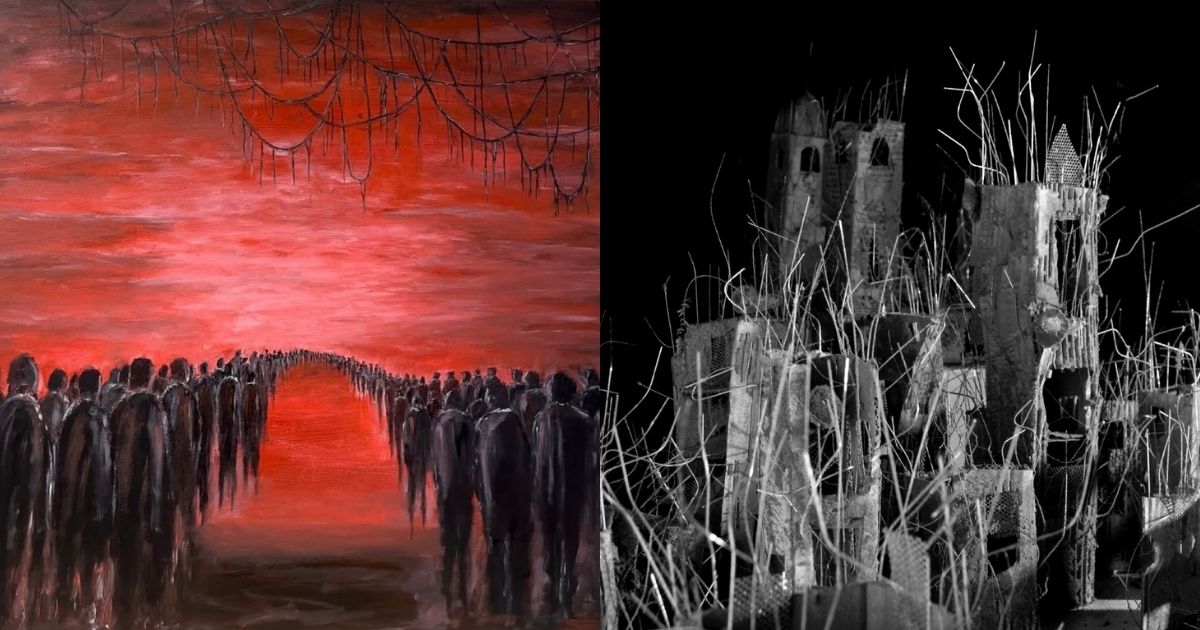
Left: The Long Walk. Right: The Fallen City.
- A common motif in your work is figures walking with their backs to the audience; what do the figures in your work represent?
- As a refugee, identity can feel suspended. You are present but often seen from a distance. By turning figures away, I create space for anonymity and universality. They carry specific histories but allow others to see themselves in that journey. It reflects the feeling of moving forward while leaving the past behind. It is not only about the Kurdish struggle. It is open, so anyone can see themselves in it, because the struggle is shared.
- How have audiences reacted to your work?
- Kurdish audiences often connect immediately. They recognize the emotions, the land, and the political context. Non-Kurdish audiences may not know the history, but they respond to the human experiences of migration, loss, and resilience. That intersection where personal history becomes shared emotion is important to me.
- What do you hope people take away from your work?
- I hope people leave with a deeper awareness of how cultures survive, especially through women. I want them to understand that identity is lived, protected, and sometimes fought for. I hope my work invites reflection rather than giving fixed answers. If my art reminds even one person that existence itself can be an act of resistance, then it has done its job.
- In my latest exhibition in Manchester, young English audiences responded deeply to abstract red paintings that were not explicitly about Kurdish or Middle Eastern identity. When I asked what they saw, their interpretations were psychological and personal. It encouraged me to continue creating both explicitly political work and more open pieces that explore the psychology of migration and struggle.
- What is the power of making art right now?
- It is powerful and important, especially at a time when the media creates stereotypes about people affected by war and displacement. Many civilians, especially women and children, suffer without understanding why. Children are born into war without knowing what peace looks like.
- Creating art is an act of resistance. It shows the real face of what is happening when politics fails. Art has a responsibility to show truth and stand in solidarity. When politics cannot fix something, art can still speak. It helps give people a voice and shows what it means to exist under these conditions.