
Art and Culture: Nuveen Barwari

“I want people to see that Kurdish culture, history, and art contain both beauty and grief. It’s full of joy, color, tragedy, resilience.”
Nuveen Barwari, an artist based in Albany, NY, uses textiles as tools of resistance, drawing on their fluidity and adaptability to reflect the shifting nature of language. Born in Nashville, TN, and raised in Duhok, Kurdistan, she has long moved between cultures, languages, and materials, a duality that influences her work.
Barwari earned a B.S. in Art from Tennessee State University in 2019 and an MFA from the University of Tennessee, Knoxville in 2022. Her work has been exhibited internationally, from Berlin to Toronto, as well as across the U.S. and Kurdistan. In 2023, she joined Skidmore College’s Art Department Workspace Residency Program, and her work has been featured in outlets including Nashville Scene, New American Painting, and Gazete Duvar.
In conversation with GKIP, Barwari reflects on her journey as a Kurdish American artist shaped by life between Nashville and Duhok, and how navigating various cultures has influenced both her identity and creative practice. She describes her shift from writing poetry in English to making visual art—a medium that allowed her to convey what words alone could not. Barwari creates pieces that hold memory, history, and the experience of diaspora through combining text, textiles, and motifs rooted in Kurdish poetry and tradition.
Through deconstructed dresses, floral imagery, and layered framing techniques, Barwari explores themes of diaspora, memory, and the reconstruction of history. Her work speaks to Kurdish, diasporic, and American audiences alike, holding space for the beauty, grief, and resilience embedded in Kurdish culture while acknowledging the complexity of living between worlds.
- To begin, can you just tell me a bit about yourself?
- I was born in Nashville, Tennessee in 1995. My parents came here from southern Kurdistan in the late 1970s, after the Algiers Agreement between the Shah and Saddam, when the border was going to be closed. Many politically active Kurds had to flee, and my parents were among them. They weren’t married at the time, each family fled separately to Iran. My dad eventually made it to the U.S., while my mom’s family went to Canada. Later, they met and got married here in the U.S.
- I moved to Duhok, Kurdistan in seventh grade because my dad was traveling a lot, and my siblings were older and married, so it was just me and my mom. I stayed there until 11th grade, then returned to the U.S. for my senior year of high school. Culturally, adjusting back was a big shift. But moving to Kurdistan at a young age, I adapted really easily.
- I went to an English-language public school there, which included both local students and others from the diaspora like me. We also had Arabic and Kurdish classes, which is how I learned to read and write Kurdish. I can read Arabic, though I don’t understand much of it.
- When I returned to the U.S., I finished high school and attended Tennessee State University in Nashville. I started as an English major but switched to art. Later, I got my MFA in art from the University of Tennessee in Knoxville. Now I’m based in Albany, NY. I’m married, my husband is from Bakur, northern Kurdistan.
- What has your relationship with art been throughout your life, especially when you decided to switch from English to art in college?
- I come from a pretty artistic family. I have relatives who pursued art academically, especially back home in Duhok. Some went to the Art Institute and earned their bachelor's and master's degrees, so that route always felt accessible.
- I was initially drawn to English because I loved poetry and writing, but over time, I realized I needed another outlet. The written word alone couldn’t fully express what I wanted to say. That’s where visual language came in. It allowed me to articulate things that writing couldn’t. Even now, those two forms are deeply intertwined in my practice.
- A lot of my work is influenced by Kurdish poetry. I’m fascinated by how poets used floral motifs to speak about political issues under oppressive regimes. For example, in classic Kurdish songs and poems, “Gul” or “Gulistan” might mean “my flower,” but it’s also a metaphor for the homeland. I’m really interested in that ambiguous space between a love song and a protest song.
-
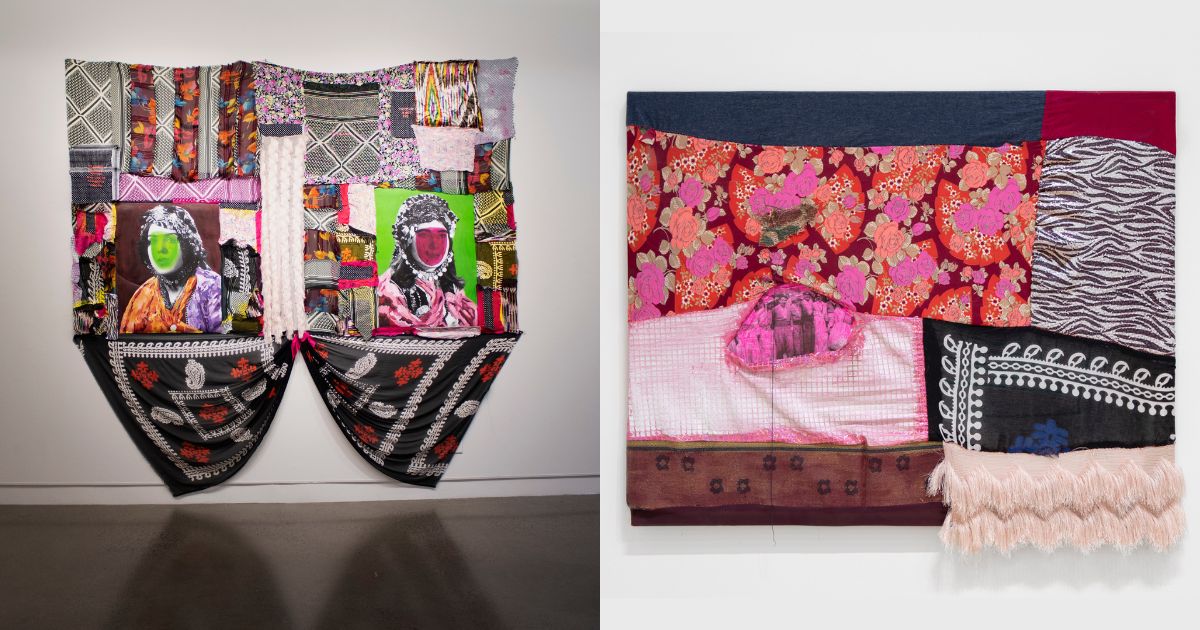
Left: here's a tribute to all the kurdish women like Jina whose names often fade into obscurity. Right: landscape of Gulistan.
- Can you talk more about how you navigate the written and visual forms in your work?
- Titles are where I bring the written form in and sometimes my titles are quite long. That’s one way I insert that expression. I also directly use text in some pieces by painting words onto surfaces.
- I’ve never liked confining myself to a single medium. Whether it’s painting, textiles, sculpture, or even podcasts, I let the concept dictate the medium. I’ve worked on t-shirts, rugs, and other formats. These are just different tools for getting out the ideas I need to express.
- I’d love to hear more about your use of florals and textiles, especially how you select and combine different materials.
- Textiles are such a part of daily life across cultures. In Kurdish culture especially, textile work—dressmaking, weaving, curtain-making—is everywhere. Living in Duhok, going to bazaars and fabric stores and watching these materials be transformed into dresses stuck with me.
- In the U.S., particularly in Nashville’s Kurdish community, I’ve been collecting old dresses and fabrics for years. People give me their older ones, especially after weddings and events. I always encourage them to reuse and pass them on within the family before donating them to me because once they do, they’ll be deconstructed.
- Over time, I’ve built a strong trust with these materials. I could close my eyes, pull out two random fabrics, and feel confident that a narrative or conversation will emerge from their pairing. I love contrast: clashing colors, textures, patterns. It becomes a metaphor for diaspora: being out of place or combining things that “don’t belong.”
- Many fabrics we call “Kurdish” are actually imported from India, Dubai, or elsewhere, so there’s this layered global history in the materials themselves.
- How do you balance your connection to both the diaspora and your homeland through your work?
- That’s always an in-between space I navigate. As an artist, I often feel I’m making work for three audiences: the Americans, the Kurds, and the Kurdish diaspora. The work never fully fits any one of them and I’ve accepted that.
- The diasporic experience is deeply personal and varies so widely. Even siblings raised in the same household can have different relationships to Kurdish identity. So I try not to worry too much about making the work universally understood.
- There’s a quote by Gloria E. Anzaldúa in her work Borderlands/La Frontera: The New Mestiza that I really love: “She reinterprets history, and using new symbols, she shapes new myths.” That speaks to me because in my work, I’m constantly reimagining and reconstructing the histories I’ve inherited.
- What does shaping new myths mean to you?
- I think of it in relation to some of my bodies of work. For example, I source black-and-white images online, paint and collage over them, reinterpreting them. Then there are my dress-based pieces, where I deconstruct traditional Kurdish dresses and layer them over colorful fabrics.
- Sometimes the dresses become faceless forms. They look like figures, like beings from an alternate realm: characters in a new myth I’m creating. That’s what the quote means to me, using inherited imagery and symbols to imagine new stories.
- I’ve noticed your use of framing in your work, especially with empty spaces and head holes in dresses or fabric breaking out of frames. Can you speak more about that?
- Frames come up often in my work. It ties back to my interest in photography and how we frame things, how a frame can direct someone’s attention and reshape perception. Putting something in a frame commands focus.
- Especially when dealing with these anonymous black-and-white portraits of Kurdish women online, there’s so little context about them. No names, no dates, no locations. Framing those images is my way of saying: pay attention. These lives mattered.
- The empty space where a face should be, or the flow of fabric breaking out of a boundary, those gestures invite people to imagine, to project. Diaspora itself feels abstract, like a place that doesn’t exist, yet we live in it. Framing and absence allow me to explore that tension.
-
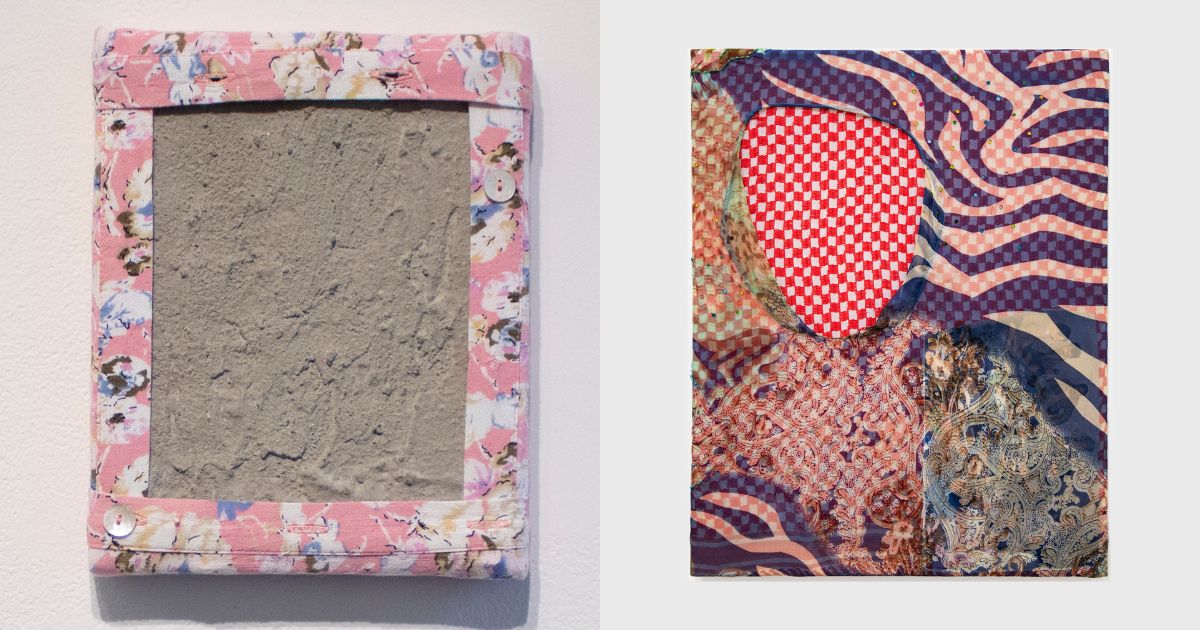
Left: view from the window. Right: cooking for the peshmergas.
- What do you hope viewers take away from your work?
- I want people to see that Kurdish culture, history, and art contain both beauty and grief. It’s full of joy, color, tragedy, resilience. There’s always pressure on Kurdish artists to be overtly political, but I think our work is inherently political, as our existence is political.
- So I also make things just because they’re beautiful, or because they make me happy. That’s just as valid.
- What challenges have you faced, navigating between different audiences?
- Kurdish audiences, whether in Kurdistan or the diaspora, tend to recognize the materials and references right away. With American audiences, I have to explain more. I often leave little “breadcrumbs” in gallery spaces to guide interpretation. I might need to explain why certain colors are meaningful or give a short history lesson before I talk about my work.
- In school critiques, my peers often held back, worried they’d offend me or my culture. And Kurdish art just isn’t as established in the U.S. as art from neighboring countries like Syria, Iran, or Turkey. But that’s changing. I’ve been connecting with more Kurdish artists across the U.S., and we have some exciting group exhibitions coming up: one in Ohio and another at George Mason University.
- What are your hopes for the future of Kurdish art?
- I’d love to see more Kurdish artists, especially those in Kurdistan, showing their work internationally. We need more infrastructure, more platforms, and ideally a bridge between artists in Kurdistan and those abroad.
- More art writing, too. Our history is rich, but much of it isn’t written down or it’s not accessible if it’s in Kurdish or Arabic. We need more Kurdish art critics and writers. When someone from your own community writes about your work, it makes a big difference. You feel understood.