
The USFP program requires 36 credit hours of graduate coursework that can be completed full-time or part-time. Students study the historical underpinnings, institutions and processes of US foreign policy; complete a rigorous course of study that features programmatic flexibility with a large number of concentrations through which they can pursue specialized interests; gain experience through practicum opportunities and internships; and learn from faculty experts with international reputations as practitioners or scholars.
Master of Arts in International Affairs: United States Foreign Policy and National Security
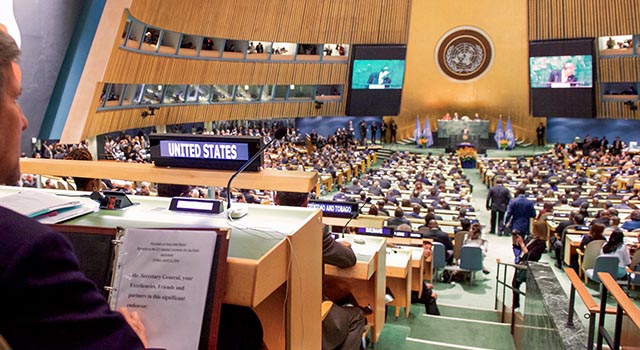
Writing the First Drafts of History

Alex Ward SIS/BA ’11, SIS/MA ’14
SIS provided a foundation for the work I do day-to-day.
They say journalism is the first draft of history. I try to think in that sense, even if I'm writing a daily story. What is the big take? Why am I writing this? What am I driving towards? And I'm always driving toward, I think, in my heart of hearts, this meta-narrative of: how is American foreign policy changing? Because it's changing so fast. And that's what I try to cover every day.
Frequently Asked Questions
When should I apply, and when are the application deadlines?
We encourage you to apply as early as you can. Applications are reviewed by round, so applying earlier means you will receive your decision sooner and can start planning accordingly. For international applicants, this provides additional time to complete the visa application process.
All applications completed on or before March 15 for fall entry and November 1 for spring entry are automatically considered for funding. Applications completed after the deadlines are considered on a rolling basis, as space and funding allow. All dates apply to both domestic and international applicants.
Fall Start
- Round 1
- October 15
- Round 2
- January 15
- Round 3
- March 15
Spring Start
- Only Round
- November 1
Where will a degree in US Foreign Policy and National Security take me?
USFP graduates go on to exciting careers in government, the private sector, and nongovernmental organizations.
Recent USFP graduates have found jobs at employers including the U.S. Department of Defense, Defense Intelligence Agency, National Endowment for Democracy, and Accenture. Within six months of graduation, 89% of graduates are working or continuing graduate studies.
Looking for more information or help? SIS has a dedicated career development center to assist current students and alumni.
Is there financial assistance available?
The School of International Service offers merit-based aid in the form of scholarships and fellowships at the time of admission. SIS also has partnerships with a number of organizations like the Peace Corps and Pickering Fellowships that provide qualified individuals with funding.
Financial aid for prospective students
United States Foreign Policy and National Security program students may choose to research other relevant fellowship opportunities.
Need-based aid is available through AU Central Office and generally takes the form of a federal low-interest loan package.
Federal loan and work study information for graduate students
Still have questions? Send us an email with program-specific questions at [email protected].