
Robert C. White, Jr. ’07: Serving the City That Raised Him
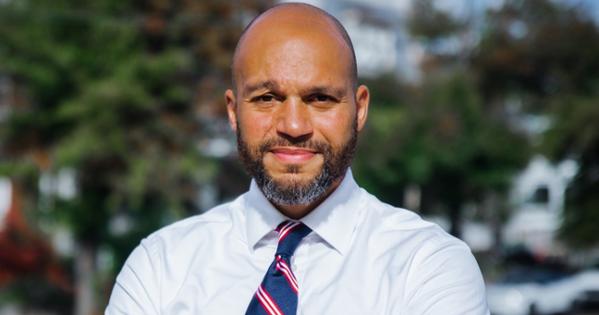
A proud fifth-generation Washingtonian, Robert C. White Jr. ’07 has spent his career serving the city he calls home. After nearly a decade on the Council of the District of Columbia, where he became a leading voice on housing affordability, economic opportunity, and democratic participation, White recently reached a new milestone in his public service journey. He just won the Democratic primary for Delegate to the U.S. House of Representatives, positioning him to become Washington, D.C.’s next representative in Congress.
The victory is the latest chapter in a career defined by a commitment to expanding opportunity and ensuring that District residents have a voice in the decisions that affect their lives. Whether serving as legislative counsel on Capitol Hill, leading community outreach efforts in the Office of the Attorney General, or representing residents on the D.C. Council, White has consistently focused on making government work for the people it serves.
But long before he held elected office, White had already developed a strong sense of how policy affects people’s lives.
Growing up in Washington, D.C., politics never felt distant. White remembers hearing hours of talk radio as a child and absorbing discussions about both national and local issues that sparked an early interest in public policy. Yet he did not initially know the path to get there.
“I always had this desire to work in public policy or be in public office,” White said. “But coming from a family that didn’t have those connections, and where most people weren’t college or law school graduates, I didn’t know what the path looked like.”
American University Washington College of Law helped illuminate that path.
Some of White’s most memorable moments during law school happened outside the classroom.
“The biggest moment for me actually happened during orientation,” he recalled. “That’s when I met my wife.”
The two did not begin dating until after graduation, but the moment remains one of White’s fondest memories from his time in law school.
Though White entered AU already interested in public service, he initially imagined practicing law for a decade before moving into policy work. Instead, his legal education accelerated that timeline. After graduating in 2007, he clerked with one of his adjunct professors and soon learned about an opportunity in the office of his hometown congressional representative, Congresswoman Eleanor Holmes Norton.
“I thought, ‘This is what I ultimately want to do,’” he said. “So, I threw my hat in the ring and hoped for the best.”
The opportunity proved transformative. White spent more than five years as legislative counsel to Norton before joining the D.C. Office of the Attorney General under Karl Racine as its inaugural director of community outreach. Those roles gave him a close look at both federal policymaking and the realities of governing at the local level.
In 2016, White decided to take a leap and run for an at-large seat on the D.C. Council.
“I was really a policy guy,” White said. “Nobody knew who I was. I didn’t know much about campaigns, and I was up against a political machine. But the things I talked about — education, housing, opportunities for people coming home from prison — those weren’t abstract issues for me.”
While White was studying for the bar exam, his brother was in federal prison. His family had also experienced housing instability while growing up in D.C. Those experiences shaped both his campaign and his approach to policymaking.
White went on to win the 2016 election with a historic vote total and was re-elected twice, building a reputation as a thoughtful policymaker and advocate for District residents.
His time at AUWCL, he says, played a critical role in shaping his career. One particularly influential experience was the Immigration Law Clinic, where he represented asylum seekers. The work was deeply meaningful, but also emotionally demanding.
“I realized I was taking the cases home with me every day,” he said. “I didn’t know how I would be okay if we didn’t win.”
The experience helped him better understand the type of work that would be sustainable for him long term and reinforced an important lesson he now shares with students.
“If there’s something you think you want to do, or something you think you don’t want to do, try it,” he advises. “You don’t want to discover years into your career that you chose the wrong path.”
In addition to his public service, White is an adjunct professor at Georgetown University Law Center, where he enjoys engaging with the next generation of legal leaders. He challenges law students to think strategically about how change actually happens.
“A lot of people want to make a difference,” he said. “But if you’re just firing shots on social media, you’re not really making progress.”
Instead, he encourages students to focus on persuasion, coalition-building, and practical solutions.
Among White’s proudest accomplishments in public office is legislation he passed in 2020 restoring voting rights to incarcerated people in the District of Columbia. The law made D.C. the only jurisdiction in the nation where voting rights are fully restored to all incarcerated residents.
“It’s something most people probably wouldn’t associate with me,” he said. “But how many people can say they’ve expanded democracy?”
Despite the demands of public life, White said the students he teaches give him hope. They are more comfortable being themselves, more aware of differences, and more willing to challenge assumptions.
“They seem more authorized to be themselves,” White said. “I’m excited to see what they’re going to do.”
White remains guided by the same values that first drew him to law and public policy. His recent primary victory represents a new opportunity to advocate for the city he has spent his life serving, this time on the national stage.
For White, that future — along with his family and the city he has spent his life serving — continues to be the greatest motivation of all.